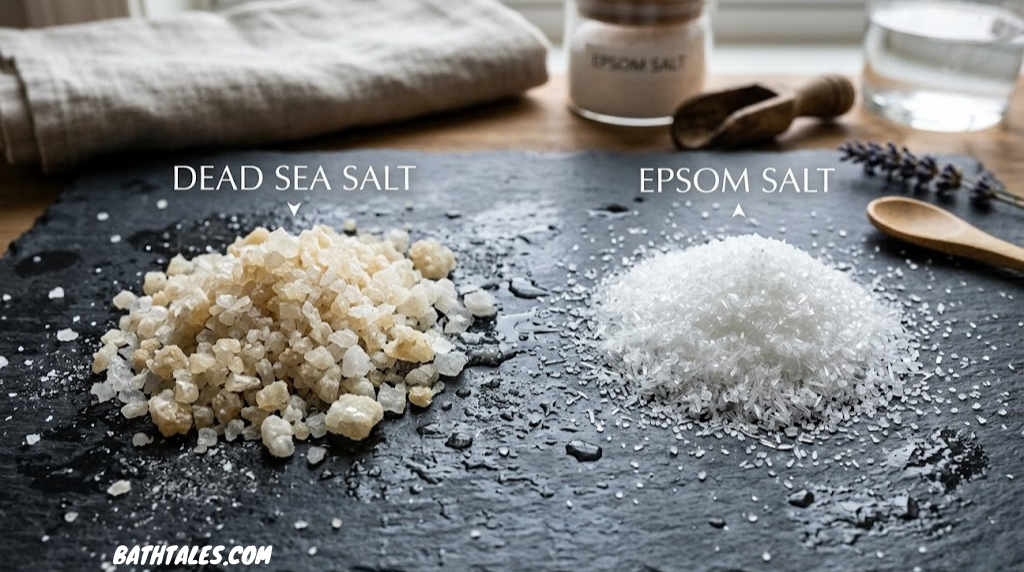
Dead Sea Salt vs Epsom Salt — Which One Should You Actually Be Using?
They’re both called “bath salts.” They’re both full of minerals. And they both make impressive claims. But they are genuinely different substances with different strengths, different mechanisms, and different ideal users. This is the comparison nobody has done properly — until now.
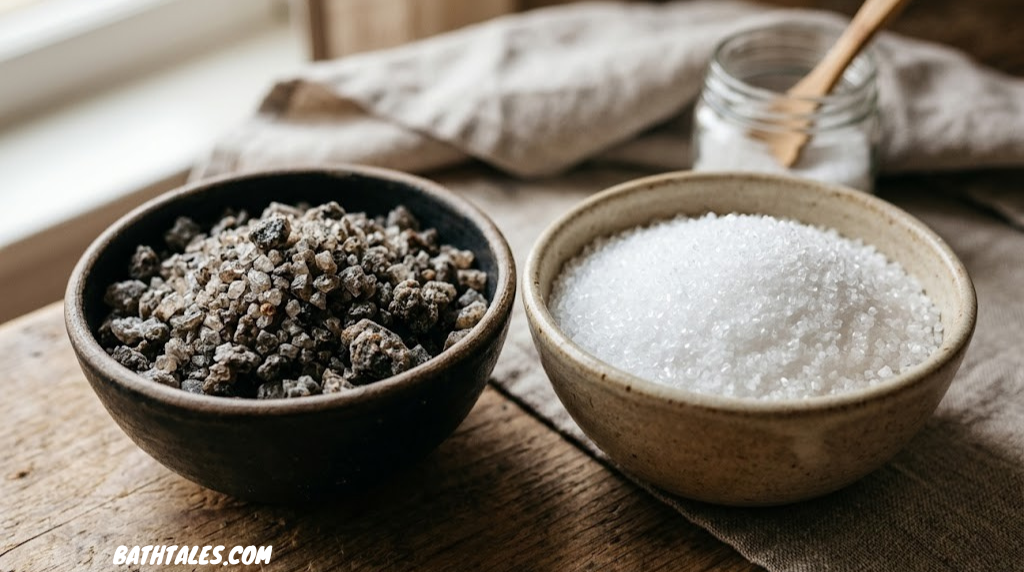
They Look Similar. They Behave Very Differently.
Ask most people what the difference is between Dead Sea salt and Epsom salt and you’ll get a shrug. Ask someone who sells them and you’ll get a pitch. Neither is what you need. What you need is the actual chemistry — what these substances are, what they do at a molecular level when they hit skin and water, and which situation each one is genuinely built for.
The confusion is understandable. Both are sold in similar packaging, both dissolve in a bath, both are promoted with words like “mineral,” “therapeutic,” and “detoxifying.” But the similarity is largely superficial. Chemically, they’re quite different. Their mineral compositions diverge dramatically. Their mechanism of action on the body — to the degree science can confirm one exists — operates through entirely different pathways.
Dead Sea salt is a complex mineral mixture harvested from one specific body of water. Epsom salt is a single compound — magnesium sulfate — that happens to be named after a town in England where mineral springs once flowed. They are not interchangeable, and picking the right one for your specific situation will make a real difference in how well your bath actually works.
This guide settles the comparison definitively. We’ll go through mineral content, skin science, clinical evidence, cost, use cases, and the specific scenarios where each clearly wins — and a few where mixing them makes more sense than choosing at all.
What Is Dead Sea Salt?
The Dead Sea is not actually a sea. It’s a landlocked salt lake sitting at the lowest point on Earth’s surface — roughly 430 metres below sea level — on the border of Jordan and Israel. Its extraordinary mineral concentration is the result of a closed-system hydrology: water flows in from the Jordan River, evaporates in the intense Middle Eastern heat, and leaves minerals behind, building in concentration over millennia.
What makes Dead Sea water — and the salt extracted from it — chemically unusual is its mineral ratio. In standard ocean water, sodium chloride (table salt) makes up roughly 97% of dissolved minerals. In the Dead Sea, sodium chloride accounts for only about 30% of dissolved salts. The remaining 70% is a complex blend of magnesium chloride, potassium chloride, calcium chloride, sodium bromide, and dozens of trace minerals. This ratio is unique in the natural world and is directly responsible for the Dead Sea’s outsized reputation in dermatology.
Dead Sea salt has been used therapeutically for centuries and, unusually for a natural remedy, has actually been studied in peer-reviewed dermatological research. Multiple clinical trials — including a frequently-cited study published in the International Journal of Dermatology — have demonstrated measurable improvements in skin hydration, roughness, and inflammation following Dead Sea mineral bathing protocols. This is not marketing copy. It’s documented clinical outcome data.
Origin & Character
Harvested from the Dead Sea (Jordan/Israel border). A complex multi-mineral salt with 21+ minerals. Sodium chloride is a minority component. Naturally high in magnesium chloride, potassium, calcium, and bromide. Not to be confused with generic sea salt.
Origin & Character
Named after Epsom, Surrey (UK). A single-compound mineral: pure magnesium sulfate. First isolated from a bitter spring. Now synthesised or mined from mineral deposits globally. Very simple, very consistent, very cheap to produce.
The most commercially available Dead Sea salts vary significantly in quality. Authentic Dead Sea salt from a certified extraction site will have a specific mineral profile that cheaper alternatives mislabelled as “Dead Sea” simply won’t replicate. Look for brands that specify their sourcing and have mineral analysis available. AHAVA, for example, is one of the few brands with full access to authenticated Dead Sea mineral extraction — something worth paying for if skin treatment is the primary goal.

What Is Epsom Salt?
Epsom salt is magnesium sulfate heptahydrate — a crystallised form of the compound MgSO₄·7H₂O. Despite its name and its long association with spa bathing, it’s chemically worlds apart from the mineral complexity of Dead Sea or ocean salt. It contains exactly two elements: magnesium and sulfate. Nothing else.
That simplicity is both its limitation and its greatest strength. Because it is a single, pure compound at consistent pharmaceutical grade, Epsom salt is extremely well understood, extremely reliable, and extremely cheap to produce. A kilogram of pure pharmaceutical-grade Epsom salt typically costs a fraction of what the same weight of Dead Sea salt costs.
The case for Epsom salt centres almost entirely on its magnesium content and whether that magnesium can be absorbed through the skin in therapeutically meaningful amounts. This is where the science gets genuinely interesting — and genuinely contested. The transdermal absorption of magnesium through intact skin is a real phenomenon supported by several studies, but the magnitude of that absorption is debated. What is less debated is that magnesium sulfate has well-documented effects on the nervous system, muscle tissue, and inflammatory responses — effects that are well-established in clinical contexts (IV magnesium is used in hospitals for eclampsia, severe asthma, and cardiac arrhythmias) even if bath soak absorption is less precisely quantified.
For those interested in a deeper dive into how Epsom salt and its close relative compare, our guide on magnesium flakes vs Epsom salt covers the transdermal absorption science in detail — including why chloride-form magnesium (as found in magnesium flakes) may absorb even more efficiently than sulfate.

Mineral Breakdown: What’s Actually in Each
This is where the comparison becomes most illuminating. The mineral profiles of Dead Sea salt and Epsom salt are not just different in degree — they’re different in kind.
Magnesium — The Overlapping Star
Both Dead Sea salt and Epsom salt are associated with magnesium — but the form matters. Epsom salt is pure magnesium sulfate; Dead Sea salt contains magnesium primarily as magnesium chloride. Research suggests magnesium chloride may have a higher transdermal bioavailability than magnesium sulfate, meaning Dead Sea’s magnesium might reach tissues more efficiently. However, in a full bath soak at the recommended quantities, both provide a meaningful magnesium environment.
Magnesium Form Comparison
- Epsom Salt: Magnesium sulfate (MgSO₄). High concentration of magnesium, but sulfate form may have limited transdermal uptake compared to chloride.
- Dead Sea Salt: Magnesium chloride (MgCl₂) among other minerals. Chloride-form magnesium is considered more bioavailable through skin.
- Magnesium Flakes (reference): Pure magnesium chloride hexahydrate — the highest-bioavailability transdermal form. See our full magnesium flakes vs Epsom comparison.
The Minerals Epsom Simply Doesn’t Have
This is Dead Sea’s decisive advantage in any mineral complexity comparison. Beyond magnesium, Dead Sea salt contains a spectrum of minerals that Epsom salt cannot offer at all, because Epsom salt has no other minerals — it is, chemically, a single compound.
Dead Sea Salt Mineral Profile (Approximate)
Note: Dead Sea composition varies by depth, season, and extraction site. These are approximate mineral ratios from published analysis data.
Epsom Salt Mineral Profile
The minerals that Dead Sea salt contains beyond magnesium each have their own physiological effects. Potassium helps regulate cell hydration and membrane function. Calcium chloride plays a role in epidermal cell differentiation. Bromide has mild sedative properties and contributes to the famously relaxing quality of Dead Sea bathing. Sodium maintains osmotic balance. Together, this mineral orchestra does something that magnesium sulfate alone simply cannot replicate.
Skin Benefits: The Comparison That Actually Matters
For anyone primarily interested in what these salts do to their skin, this section is the most important part of the comparison. The evidence base here is significantly stronger for Dead Sea salt — and it’s worth being honest about that difference rather than presenting both as equal.
Dead Sea Salt and Skin: The Clinical Case
The skin benefits of Dead Sea minerals have been documented in multiple peer-reviewed studies, making this one of the few areas where bath salt claims are actually backed by clinical evidence. Research has demonstrated measurable improvements in:
- Skin hydration: Transepidermal water loss (TEWL) — the rate at which moisture escapes through the skin barrier — is significantly reduced after regular Dead Sea mineral baths. This is a meaningful, measurable outcome, not an anecdotal impression.
- Skin roughness: Study participants with dry, rough skin showed consistent reduction in roughness scores after bathing protocols using Dead Sea minerals versus plain water or sea salt controls.
- Eczema (atopic dermatitis): One of the most well-replicated findings in Dead Sea research is improvement in eczema symptoms. The combination of magnesium’s anti-inflammatory effects, potassium’s barrier-support role, and bromide’s calming properties appears to address multiple drivers of eczema simultaneously.
- Psoriasis: Balneotherapy (therapeutic bathing) at the Dead Sea has decades of clinical documentation for psoriasis management. The UVB component of actual Dead Sea sunlight is part of that protocol, but the mineral bathing component independently contributes to plaque reduction.
For anyone managing chronically dry skin, the Dead Sea mineral research is compelling enough to make it the clear primary recommendation. Our full guide to the best bath salts for eczema explores the clinical protocols in practical detail.
Epsom Salt and Skin: More Modest Claims
Epsom salt’s skin benefits are real but narrower in scope. Magnesium sulfate is genuinely anti-inflammatory — a property well-established in clinical medicine — and that anti-inflammatory effect extends to the skin surface, potentially helping with redness, minor irritation, and the inflammatory component of conditions like acne or contact dermatitis.
Epsom salt is also used in cosmetic contexts as a mild exfoliant when applied directly in paste form. As a bath soak, its exfoliating effect is minimal, but the softening of skin following a warm-water Epsom soak is genuine — partly due to the warm water itself and partly due to the mild keratolytic (skin-softening) effect of sulfate ions.
For sensitive skin specifically, Epsom salt’s simplicity is actually an advantage in one scenario: if someone has contact allergies to multiple minerals or plant extracts, a plain Epsom salt soak has a shorter ingredient list and therefore fewer potential triggers. But for skin that’s simply dry, dehydrated, or barrier-compromised, Epsom doesn’t have the mineral toolset that Dead Sea brings.
Dead Sea — Skin Pros
- Clinically proven skin hydration
- Reduces transepidermal water loss
- Multiple minerals support barrier repair
- Bromide aids skin calming
- Documented benefit for eczema/psoriasis
Epsom — Skin Pros
- Anti-inflammatory (magnesium)
- Softens skin in warm water
- Very simple ingredient list (fewer allergens)
- Good for minor skin irritation
Muscle Recovery & Post-Workout Soaking
This is the category where the contest is much closer — and where most people intuitively reach for Epsom salt, with good reason. The muscle-and-magnesium story is well-established even if the transdermal pathway is contested, and for athletes and anyone dealing with post-exercise soreness, Epsom’s concentrated magnesium is the most direct route.
Why Epsom Salt Has the Edge for Muscles
Magnesium is essential for muscle function at a fundamental level. It’s required for ATP (adenosine triphosphate) production — the molecule that powers every muscle contraction. Magnesium deficiency is associated with increased muscle cramping, prolonged recovery times, and heightened sensitivity to pain. A significant percentage of people are functionally magnesium-deficient due to dietary patterns and soil depletion, making magnesium replenishment genuinely therapeutic for muscle-related symptoms rather than just pleasant.
Epsom salt’s high magnesium concentration — and its affordability, which makes generous dosing practical — gives it a meaningful advantage here. You can use two to three full cups of Epsom salt per bath without financial concern. Doing the same with premium Dead Sea salt would be expensive. More magnesium in the water means more opportunity for transdermal absorption, which means more potential benefit for fatigued or sore muscles.
For athletes specifically, our guide to the best bath salts for athletes explores recovery protocols in detail, and Epsom salt features prominently — for good reason. For muscle soreness specifically, Epsom is the most cost-effective, evidence-adjacent choice.
Dead Sea’s Counterpoint
Dead Sea salt isn’t without muscle-related benefit. Its magnesium chloride content addresses the same mineral pathway, and bromide adds a nervous-system calming effect that reduces the perception of muscle tension. Many users report that a Dead Sea soak feels more deeply relaxing than an Epsom soak — less “therapeutic gym recovery” and more “genuine unwinding.” This is partly placebo, partly the broader mineral environment, and partly real bromide pharmacology.
If your soaking goal is as much about calming the nervous system and reducing stress hormones (which absolutely contributes to faster muscle recovery) as it is about direct muscle chemistry, Dead Sea has a credible case. But if your only goal is maximum magnesium delivery for muscle repair on a realistic budget, Epsom wins on economics.

Relaxation, Sleep, and Stress Relief
The relaxation category is where Dead Sea salt quietly makes its most interesting case. When people describe a Dead Sea soak as “unlike any other bath,” the unusual quality they’re sensing is largely attributable to bromide — a mineral virtually absent from Epsom salt but present in meaningful concentrations in authentic Dead Sea salt.
Bromide: Dead Sea’s Secret Relaxation Weapon
Bromide ions have a well-established mild sedative and anxiolytic (anti-anxiety) effect. Historically, bromide compounds were used as medical sedatives before the development of modern pharmacology. In Dead Sea salt, bromide is present at concentrations that are pharmacologically active at the skin surface and potentially through transdermal routes — enough to contribute to the distinctive calming quality that Dead Sea bathers consistently report.
This is not the case with Epsom salt. While magnesium itself has well-documented effects on the GABA receptor system (the same pathway targeted by benzodiazepines and alcohol) — and therefore does have genuine calming properties — Epsom lacks bromide entirely. The relaxation profile of the two salts, while overlapping, is meaningfully different.
For users seeking bath soaks specifically to support better sleep and stress relief, Dead Sea salt’s broader mineral action gives it a slight but real edge. For those interested in enhancing both salts’ relaxation potential, our resource on the best essential oils to add to bath salts covers aromatherapy additions that deepen the effect of either choice.
Dry Skin and Eczema: The Clearest Category Win
If you have dry skin or eczema — whether chronic or seasonal — this comparison has already been partially settled by clinical research, and Dead Sea salt is the overwhelming winner. This is one of the rare beauty claims that has been put through actual controlled trials rather than consumer testimonials.
A study published in the International Journal of Dermatology (Proksch et al.) specifically tested forearm skin bathed in Dead Sea salt solution versus tap water versus sodium chloride solution. The Dead Sea salt group showed significantly lower transepidermal water loss, improved skin hydration, reduced skin roughness, and reduced inflammation compared to both controls. The sodium chloride control — essentially just salty tap water — showed no meaningful improvement, demonstrating that it’s specifically the Dead Sea mineral complex that drives the benefit, not salt in general.
Epsom salt’s case for dry skin is less convincing. While some users find magnesium sulfate soaks soothing, there is no equivalent clinical evidence that Epsom salt baths improve skin barrier function or measurably reduce dryness. The anti-inflammatory effect of magnesium helps with reactive, inflamed skin — but it doesn’t address the root cause of dry skin the way the multi-mineral Dead Sea environment does.
For eczema specifically: The clinical recommendation is consistent — Dead Sea mineral bathing, fragrance-free formula, lukewarm water (not hot), 15–20 minutes, followed immediately by emollient application while skin is still damp. This protocol has the best-documented outcomes for atopic dermatitis management through bathing. Full guide: best bath salts for eczema.

Detox Claims: What’s Real, What Isn’t
Both Dead Sea salt and Epsom salt are frequently marketed with “detox” language, and both attract healthy skepticism from dermatologists and toxicologists. Let’s separate the plausible from the promotional.
What “Detox” Actually Means in a Bath Context
The liver and kidneys are the body’s actual detoxification organs. A bath — regardless of what’s dissolved in it — does not meaningfully accelerate the removal of metabolic waste from internal organs. The idea that sweating in a hot bath “draws out toxins” through the skin has no credible scientific support. Sweat is primarily water and electrolytes — the compounds lost in sweat are trivial compared to what the liver and kidneys process.
What is real and what bath soaks can legitimately address is surface-level: removing dead skin cells, excess sebum, environmental residue, and surface bacteria through warm water, gentle osmosis, and the mild exfoliating effect of dissolved minerals. That’s a genuine and useful thing — just not a toxin purge.
Both Dead Sea salt and Epsom salt can contribute to this surface cleansing. Dead Sea salt’s complex mineral environment may slightly enhance it through the osmotic gradient created at the skin surface. If detox benefits are a primary goal, our guide to the best detox bath salts covers formulas that combine mineral salts with activated charcoal or bentonite clay for more targeted surface detox action.
Cost and Value: The Practical Comparison
This category is Epsom salt’s most dominant win, and the margin is not close. The economics of these two salts are so different that cost alone will be the deciding factor for many regular users.
| Factor | Dead Sea Salt | Epsom Salt |
|---|---|---|
| Typical Price (2 lb) | $12–$30+ | $4–$9 |
| Cost per bath | $3–$8 | $0.50–$1.50 |
| Dose per bath | 1–1.5 cups (more concentrated) | 2–3 cups (standard) |
| Clinical skin evidence | Strong (multiple RCTs) | Limited (mechanism supported) |
| Mineral complexity | 21+ minerals | 1 compound (MgSO₄) |
| Availability | Specialty / online | Everywhere |
| Shelf life | Indefinite (minerals) | Indefinite (pure compound) |
| Sustainable daily use | Moderate budget needed | Extremely affordable |
For context: the recommended amount of Epsom salt for a full bath is 2 cups, and a large 6-pound bag (costing $10–15) gives you roughly 12 baths. A similarly sized bag of premium Dead Sea salt might give you the same number of baths at 3–4× the cost. For daily or near-daily soaking — which is ideal for managing chronic dry skin or maintaining a recovery routine — that cost difference is not trivial over months of use.
A smart strategy that many regular bathers use: Epsom salt as the daily-use workhorse for general mineral soaking and muscle recovery, with Dead Sea salt reserved for targeted skin-treatment sessions two to three times per week. It’s not either-or. More on this in the mixing section below.
Which Should You Choose? A Direct Answer
Rather than giving you a wishy-washy “it depends” answer, here are clear, specific recommendations based on your primary reason for using bath salts.
Choose Dead Sea Salt If…
- Your primary goal is skin hydration and barrier support — especially for chronically dry or dehydrated skin.
- You have eczema, psoriasis, or atopic dermatitis and want the most clinically validated bathing option.
- You have sensitive or reactive skin and want mineral diversity that addresses multiple aspects of skin health simultaneously.
- You’re managing skin conditions during pregnancy (fragrance-free Dead Sea salt is well-tolerated; see our guide to bath salts for pregnancy for safe protocols).
- You want the deepest relaxation and nervous system calming — the bromide component of Dead Sea salt is genuinely distinctive.
- You want to make your own formulas — our guide to how to make bath salts at home shows how to build blends around a Dead Sea base.
Choose Epsom Salt If…
- Your primary goal is muscle recovery and post-workout soaking — the high magnesium concentration at an affordable dose is the best setup for this.
- You soak daily or near-daily and cost is a constraint. Epsom’s economics make it the sustainable choice for high-frequency use.
- You want a simple, reliable product with a short ingredient list — ideal for people who react to complex mineral formulas or added botanicals.
- You’re looking for an affordable foot soak for tired, aching feet — Epsom is the classic for a reason.
- You want a gentle, affordable addition to a skin cleansing routine where dramatic skin treatment isn’t the goal.
If you’re completely new to bath salts and not sure which to start with:
Start with Epsom salt for two weeks. It’s inexpensive, widely available, and teaches you how to build a consistent soaking routine (temperature, timing, post-bath moisturizing) without a significant financial commitment. Then add Dead Sea salt sessions for targeted skin benefit. Our guide to bath salts for every type of soak is a good companion resource for understanding which goal maps to which salt type.
Can You Mix Dead Sea Salt and Epsom Salt?
Yes — and this is actually one of the most sensible approaches for anyone who wants mineral diversity without paying full Dead Sea prices on every soak. The two salts are chemically compatible; there’s no reaction between magnesium sulfate (Epsom) and the chloride salts that make up most of Dead Sea’s mineral complex. In fact, some commercial bath salt blends already do this — marketing a product as a “mineral blend” that contains both Epsom and Dead Sea components.
A Practical Mixing Protocol
For a bath that combines Epsom’s muscle-recovery magnesium concentration with Dead Sea’s skin-protective mineral complexity, a workable blend is:
- 1½ cups pharmaceutical-grade Epsom salt
- ½ to ¾ cup authentic Dead Sea salt
- 1 tablespoon sweet almond or jojoba oil (optional, for added skin emolliency)
- 5–8 drops of lavender or chamomile essential oil (optional, see our essential oil guide)
This gives you a high magnesium environment from the Epsom, meaningful trace mineral diversity from the Dead Sea, and at a cost-per-bath that’s much more sustainable than a pure Dead Sea soak. For a complete guide to building your own custom blends, see how to make bath salts at home.
One caution when mixing: Adding very large amounts of any salt creates a highly concentrated osmotic environment. At extreme concentrations, bath water can actually pull moisture from skin rather than delivering it. Stick to the proportions above — the goal is mineral enrichment, not creating a salt lake in your tub. More on optimal dosing in our guide to how much bath salt to use.
Full Head-to-Head Comparison Table
| Category | Dead Sea Salt | Epsom Salt | Winner |
|---|---|---|---|
| Chemical identity | Complex multi-mineral mixture | Single compound (MgSO₄) | — |
| Mineral diversity | 21+ minerals | 1 (MgSO₄) | Dead Sea |
| Magnesium content | High (chloride form) | Very high (sulfate form) | Tie |
| Potassium | Significant (~24%) | None | Dead Sea |
| Bromide (relaxation) | Present | Absent | Dead Sea |
| Skin hydration | Clinically proven | Limited evidence | Dead Sea |
| Eczema/psoriasis | Multiple clinical studies | Some benefit | Dead Sea |
| Muscle recovery | Good | Very good (high Mg dose) | Epsom |
| Relaxation effect | Broader (bromide + Mg) | Good (Mg-GABA pathway) | Dead Sea — slightly |
| Cost per bath | $3–$8 | $0.50–$1.50 | Epsom |
| Availability | Specialty/online | Universal | Epsom |
| Daily use sustainability | Moderate cost | Very affordable | Epsom |
| Fragrance-free options | Available | Available | Tie |
| Shelf life | Indefinite (minerals stable) | Indefinite (pure compound) | Tie |
| Organic/natural sourcing | Natural lake extraction | Often synthesised | Dead Sea |
| Clinical evidence overall | Strong (RCTs for skin) | Moderate (mechanism established) | Dead Sea |
Dead Sea salt wins: 8 categories. Epsom salt wins: 4 categories. Tied: 4 categories.
Scenario-by-Scenario Pick Guide
Not sure which applies to you specifically? Use this quick-reference grid. Each scenario names the better choice and why.
Post-Workout Recovery
You need high-dose magnesium at a cost that makes twice-weekly soaks sustainable.
Epsom SaltDry or Eczema Skin
Clinical evidence is on Dead Sea’s side. The mineral complex actively supports barrier repair.
Dead Sea SaltRelaxation & Sleep Aid
Bromide in Dead Sea salt adds a genuine calming dimension beyond what magnesium alone offers.
Dead Sea SaltDaily Budget Soak
Epsom salt at $0.50–$1.50 per bath is simply incomparable for sustainable daily use.
Epsom SaltPregnancy Safe Soak
Plain Epsom or fragrance-free Dead Sea, lukewarm water. Check specific guidance: bath salts for pregnancy
Either (Fragrance-Free)Foot Soak
Epsom is the classic, practical, affordable foot soak. Dead Sea is also excellent but harder to justify the cost in a foot basin.
Epsom SaltPsoriasis Management
Dead Sea mineral bathing has the strongest published evidence base for psoriasis of any bath salt type.
Dead Sea SaltSensitive Skin
Fragrance-free Dead Sea is excellent. If multiple mineral allergies are a concern, plain Epsom’s short ingredient list may be safer. See: sensitive skin guide
Situation-DependentDIY Blending
Both work beautifully as blend bases. Dead Sea for skin focus, Epsom for muscle focus. Or combine both for the best of both.
Mix BothTop Dead Sea Salt Picks to Buy
If you’ve decided Dead Sea salt is right for your goals, here are the most trustworthy options on the market — prioritising authentic mineral sourcing and dry-skin or eczema-focused formulas.
AHAVA Dead Sea Bath Salt
The most clinically referenced Dead Sea salt brand. Uses the proprietary Osmoter™ complex that mirrors the authentic Dead Sea mineral ratio. No synthetic fragrance, suitable for sensitive and eczema-prone skin. The purist’s choice when results matter more than price.
Salinac Dead Sea Bath Salts with Botanical Oils
21-mineral Dead Sea salt combined with sweet almond and jojoba oil — the mineral-plus-lipid combination that dry skin genuinely needs. Calming lavender scent from natural essential oil. Large jar, good value. Ideal if you want oils built into the formula rather than adding them separately.

For more options, our complete guide to the best bath salts for dry skin reviews 12 products in detail, and the best organic bath salts guide covers natural-sourced Dead Sea options for clean beauty buyers.
Top Epsom Salt Picks to Buy
The Epsom salt market has a genuinely wide quality range — from bare pharmaceutical-grade magnesium sulfate to beautifully formulated blends with organic oils and aromatherapy botanicals. Here are the standouts.
Dr Teal’s Pure Epsom Salt with Coconut Oil
The accessible workhorse of Epsom salts. Pharmaceutical-grade magnesium sulfate combined with fractionated coconut oil — one of the most skin-compatible carrier oils. Widely available, great value per bath, and pleasantly scented in a range of light fragrances. The most logical starting point for anyone new to Epsom salt soaking.

Sky Organics Epsom Salt with Organic Argan Oil
USDA-certified organic argan oil paired with pharmaceutical-grade Epsom salt. Argan’s exceptionally high oleic acid and tocopherol content makes this the most skin-nourishing Epsom variant available. Unscented option available — a strong choice for anyone wanting Epsom’s muscle benefits with meaningful skin emolliency added.
Frequently Asked Questions
No — they’re significantly different, and the distinction matters. Regular sea salt is predominantly sodium chloride (typically 97%+ NaCl) with trace amounts of other minerals. Dead Sea salt is a completely different mineral profile: sodium chloride accounts for only about 30% of its composition, with the remainder being magnesium chloride, potassium chloride, calcium chloride, bromide, and trace minerals. This is why studies showing benefits from Dead Sea bathing don’t apply to generic sea salt — the sodium chloride control group in clinical trials typically shows no meaningful skin improvement.
Yes, they are chemically compatible and can be combined safely. A practical blend is 1.5 cups Epsom salt plus 0.5–0.75 cups Dead Sea salt, which gives you the high magnesium concentration from Epsom alongside the mineral diversity of Dead Sea salt. This combination is more cost-effective than using pure Dead Sea for every soak and still provides meaningful mineral complexity. Many commercial “mineral blend” bath salts already combine both types. Avoid using very large amounts of either in combination — the combined osmotic concentration of a very heavy mix can reverse the hydration benefit.
Epsom salt is the more practical choice for muscle cramps specifically. Its very high magnesium concentration (and the availability of magnesium in large amounts at low cost) makes it better suited for the targeted magnesium delivery that addresses the physiological driver of most muscle cramping — magnesium deficiency in muscle tissue. Dead Sea salt also contains magnesium and will help, but the cost per bath makes it less sustainable for the frequent soaking that cramp management often requires. For acute post-exercise recovery, use 2–3 cups of Epsom salt in a warm bath for 15–20 minutes.
Transdermal magnesium absorption is real, but its magnitude has been overstated in popular wellness culture. A study published in the Journal of Integrative Medicine (Rosemary Waring, 2006) found that participants who soaked in Epsom salt baths showed increased serum and urine magnesium levels compared to controls, supporting the absorption mechanism. However, the increase was modest — not equivalent to oral magnesium supplementation. The skin is a selective barrier: some minerals cross it, but not freely and not in large quantities. The clinical effects attributed to Epsom salt bathing (muscle relaxation, reduced soreness, improved sleep) are real for many users, even if the exact contribution of transdermal absorption versus other soak benefits (warmth, relaxation, stress relief) remains partially unclear.
Dead Sea salt is safe for daily use in appropriate amounts, though the cost makes it impractical for many people on a daily basis. Clinical protocols for skin conditions typically use Dead Sea mineral baths two to three times weekly. Daily use is more common in actual Dead Sea spa settings where the water is freely available. If you’re using Dead Sea salt daily at home, stick to one cup per bath (the mineral concentration is already higher than Epsom), keep water temperature moderate, and always moisturise immediately after. For general daily soaking, Epsom salt is more economical and equally safe. Both have indefinite shelf lives when stored in airtight containers — see our guide on whether bath salts expire.
Dead Sea salt, definitively. This is one of the clearest category wins in the comparison and one of the few bath salt claims backed by peer-reviewed clinical research. A controlled study specifically comparing Dead Sea salt solution to tap water and plain sodium chloride solution found that Dead Sea salt significantly reduced transepidermal water loss, improved skin hydration, and reduced skin roughness and inflammation. Epsom salt’s anti-inflammatory magnesium does help with eczema symptoms, but it doesn’t replicate the multi-mineral action that drives Dead Sea’s documented outcomes. For practical protocols, see our guide to the best bath salts for eczema.
The amounts differ because of the mineral concentration difference. For Epsom salt: 2 cups (approximately 480g) per average-sized bathtub. For Dead Sea salt: 1 to 1.5 cups (approximately 250–380g) per bath — it’s more concentrated, so you need less for equivalent mineral exposure. If combining both in one bath, use 1.5 cups Epsom plus 0.5–0.75 cups Dead Sea salt. For a full breakdown by body area, soak goal, and skin condition, our guide to how much bath salt to use covers every scenario.
Dead Sea salt has a slight edge for relaxation and sleep, primarily because of its bromide content. Bromide is a naturally occurring mild sedative that acts on the central nervous system — a property that was exploited medically before modern pharmacology developed safer alternatives. Authentic Dead Sea salt contains bromide at concentrations that may be pharmacologically active transdermally, contributing to the distinctive quality of deep relaxation that Dead Sea bathers consistently report. Epsom salt’s magnesium is also genuinely relaxing through its interaction with GABA receptors, but it lacks the bromide component. Both benefit from enhancement with calming essential oils — see our relaxation and sleep guide for the full picture.
Himalayan salt occupies a middle position. It contains 84 trace minerals (more mineral diversity than Epsom, but less targeted mineral concentration than Dead Sea), is naturally coloured by iron oxide rather than dyes, and has a pleasant aesthetic. For dry skin or eczema management, Dead Sea’s magnesium-potassium-bromide complex still has the stronger clinical basis. For muscle recovery, Epsom’s concentrated magnesium still has the cost advantage. Where Himalayan shines is as an all-purpose mineral soak with broad trace element coverage, an attractive appearance, and good availability at reasonable cost. For a complete look at the Himalayan category, see our guide to the best Himalayan pink bath salts.
For both types, the optimal soak duration for most goals is 15 to 20 minutes. This is long enough for meaningful transdermal mineral interaction and the physiological effects of warm water immersion, but not so long that you begin to experience net water loss through osmosis or overly long heat exposure. Clinical Dead Sea protocols for skin conditions typically use 20-minute soaks. For muscle recovery with Epsom, the same timing applies, though some athletes extend to 25 minutes without issue. Beyond 30 minutes in concentrated salt water, the benefit curve flattens and can reverse for skin hydration. Our full guide to how long to soak in bath salts covers timing by goal and skin type.
The Bottom Line
Dead Sea salt and Epsom salt are not really competitors for the same crown — they’re excellent at different things, and the smart move is to understand which one your specific situation calls for rather than picking a universal favourite.
Dead Sea salt is the mineralogically richer, clinically better-evidenced choice for skin health — particularly for dry skin, eczema, and psoriasis. Its multi-mineral complexity, bromide content, and decades of dermatological research behind it make it the serious bather’s choice when skin treatment is the goal. It is meaningfully more expensive, but for targeted therapeutic use, that premium is justified by documented results.
Epsom salt is the economical, accessible, high-magnesium workhorse. For muscle recovery, daily soaking, budget-conscious regimens, and anyone new to mineral bathing who wants to build a consistent routine without financial commitment, it is genuinely hard to beat. The muscle recovery evidence base, while not as watertight as Dead Sea’s skin research, is credible enough to explain why it remains the most popular bath salt in the world by a substantial margin.
The smartest approach is not a binary choice. Use Epsom salt for your frequent soaks. Use Dead Sea salt two to three times weekly when skin treatment, deep relaxation, or eczema management is the priority. Blend them when you want both mineral worlds. And when either needs enhancing, the right essential oils and botanical additions can take a good bath salt soak and make it a genuinely therapeutic experience.
Ready to Stock Your Bath?
Choose your primary goal and pick the salt that actually serves it. Both links include our affiliate tag — you pay no extra, but it helps keep this content going.