Detox Bath Salts 101: How to Choose, Use, and Soak Like You Mean It
A mineral-by-mineral, myth-by-myth guide to picking a detox bath salt that actually earns a spot on the edge of your tub.
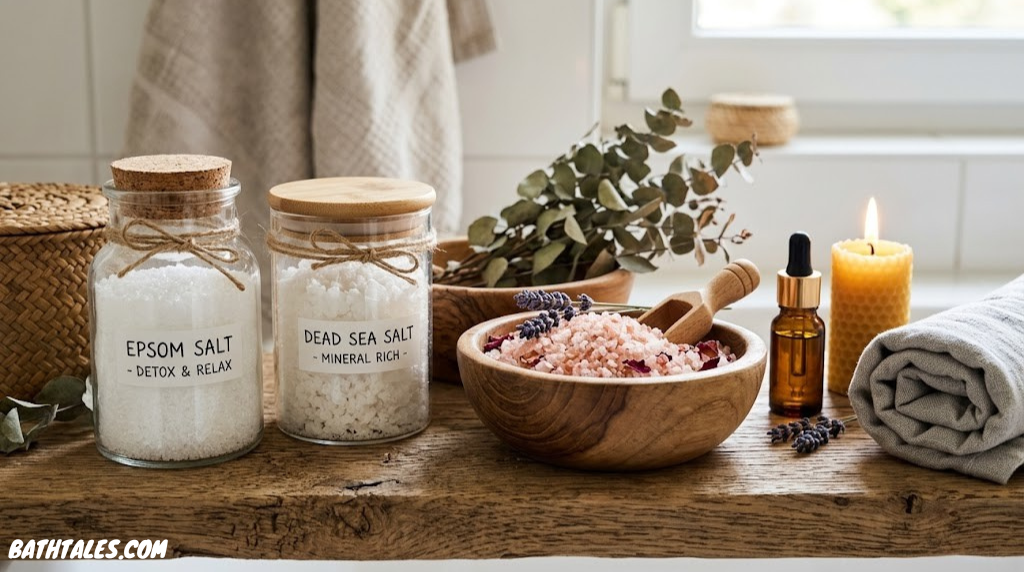
Quick note: this guide contains Amazon affiliate links. If you buy through one of them, we may earn a small commission at no extra cost to you — it’s how we keep testing salts so you don’t have to guess.
There’s a particular kind of quiet that happens when you sink into a warm bath after a day that asked too much of you. The water clouds slightly as the salts dissolve, the muscles in your shoulders finally agree to unclench, and for twenty minutes the only task on your list is breathing. That feeling is a big part of why detox bath salts have become such a fixture in self-care routines — and also why the shelf in front of you at the store (or the search results in front of you right now) can feel so crowded and confusing.
“Detox” is a loaded word in the wellness aisle, and we’re not going to pretend otherwise. Some of the claims attached to bath salts are backed by real, if modest, science. Others are marketing shorthand that’s been repeated so often it sounds like fact. Our approach in this guide is to sort one from the other as we go, so you walk away knowing exactly what a soak can realistically do for you, what it can’t, and which products are worth the cabinet space.
Below, we’ll walk through what detox bath salts actually are, the minerals that make up the major categories, an honest look at the research behind “detox” claims, six well-known products worth considering, and practical guidance on dosage, timing, and safety.
What Are Detox Bath Salts, Exactly?
Strip away the marketing language and a detox bath salt is, at its core, a mineral salt formulated to dissolve completely in warm bathwater. The base is almost always one of four things: magnesium sulfate (better known as Epsom salt), magnesium chloride flakes, sodium chloride harvested from a mineral-dense source like the Dead Sea, or rock salt mined from deposits such as the Himalayan foothills. From there, brands layer in extras — essential oils, dried botanicals, clays, charcoal, or color — and package the whole thing under a “detox” or “cleanse” label because that’s the language shoppers search for.
The “detox” name is doing a lot of marketing work here, and it’s worth understanding what it’s actually claiming. In most product descriptions, “detox” is shorthand for a soak that’s meant to feel cleansing: it draws on the visual of cloudy, mineral-rich water, the sensation of warmth opening your pores, and the ritual of stepping out feeling lighter. It is not, in almost every case, a clinical claim that the product removes measurable toxins from your bloodstream.
Functionally, detox bath salts fall into a few overlapping categories. Mineral soaking salts are the simplest: just the salt, sometimes with a light scent, meant to be dissolved in bulk for a long soak. Therapeutic blends add eucalyptus, arnica, or menthol and are marketed toward muscle recovery or congestion relief. Spa-style aromatherapy salts lean into lavender, chamomile, or citrus oils and are positioned for relaxation and sleep. Clay or charcoal-infused salts add a visual “drawing out impurities” effect, even though the actual mechanism is more about gentle exfoliation and surface-oil binding than anything happening at a cellular level.
What ties all of these together is the delivery method: full-body immersion in warm water for somewhere between fifteen and thirty minutes, long enough for the water temperature to encourage blood flow to the skin’s surface and for the ritual itself to do a lot of the relaxation heavy lifting.
It’s also worth noting what detox bath salts are not. They are not a substitute for medical detoxification protocols, nor are they a treatment for any diagnosed condition. They sit firmly in the self-care and wellness category — closer to a scented candle than to a supplement — and the most honest brands market them that way. Understanding that distinction is the difference between buying a product that disappoints you and buying one that does exactly what it was always capable of doing.
The Science Behind Detox Soaks: What’s Proven and What’s Folklore
Let’s start with the organs actually responsible for detoxification, because they’re not your skin. Your liver and kidneys work continuously, filtering metabolic waste and processing substances out of your bloodstream whether or not you’ve taken a bath that week. Your lungs and digestive system play supporting roles. This system runs on its own; it doesn’t pause for a lack of bathing and it doesn’t get a meaningful boost from sitting in mineral water.
That said, “bath salts don’t detox you” is not the same as “bath salts don’t do anything.” There are a handful of effects that are genuinely well-supported. Warm water immersion increases blood flow to the skin and muscles — a well-documented response and one reason a hot soak can ease the perception of soreness after exercise. The buoyancy of water also takes weight off joints, which is part of why warm soaks are often recommended for people managing joint discomfort.
Then there’s magnesium, which is the most contested ingredient in this entire category. The popular claim is that soaking in Epsom salt allows magnesium to absorb through your skin and raise your body’s magnesium levels. The research here is genuinely mixed: a small number of studies have measured modest increases in blood magnesium after Epsom salt baths, but the body of evidence is thin, sample sizes are small, and dermatologists generally agree that skin is an effective barrier specifically designed to keep most things — including minerals — from passing through it in large quantities.
What’s much less debatable is the psychological and sensory side of soaking. The ritual of setting aside time, dimming the lights, and sitting in warm water triggers a real parasympathetic nervous system response — the “rest and digest” state that lowers heart rate and reduces the stress hormone cortisol. Some of this is the warmth itself; some of it is the simple act of doing something deliberately restful instead of scrolling a phone.
Our honest take: think of detox bath salts as a relaxation and comfort product with a side of mineral-rich water, not a cleansing treatment. Sold that way, they’re a genuinely good value. Sold as a toxin-removal system, they’re overpromising.
Plenty of wellness products work primarily through comfort, ritual, and sensory experience rather than dramatic physiological change, and there’s nothing wrong with that. The problem only shows up when marketing convinces someone to expect a medical-grade outcome from a bath. Go in expecting relaxation, mild muscle relief, and softer-feeling skin, and detox bath salts are very likely to meet your expectations.
Key Minerals in Detox Bath Salts and What They Actually Do
Nearly every detox bath salt on the market is built around one of a small handful of base minerals, and understanding what each one is — chemically and practically — makes label-reading a lot less mysterious.
Magnesium sulfate (Epsom salt) is the most common base in the category and usually the cheapest. It dissolves quickly and completely in warm water, leaving no visible residue. It’s been used in folk remedies for muscle soreness for generations, and while the transdermal absorption question remains unsettled, the warm-water-plus-ritual effect on perceived soreness is consistently reported by users.
Magnesium chloride, usually sold as “magnesium flakes,” is a different magnesium compound that some brands market as more bioavailable through skin than sulfate-based Epsom salt. The evidence for that specific bioavailability claim is thinner than the marketing suggests, but magnesium chloride flakes do dissolve readily and many users report the same soothing sensation. It often comes down to texture preference and price rather than a meaningful difference in outcome.
Dead Sea salt is chemically simple table salt but harvested from water with an unusually high concentration of trace minerals — magnesium, potassium, calcium, and bromide among them. It has a longer history of use in dermatology-adjacent skincare than most other bath salts, partly because some small studies have looked at its effects on psoriasis and eczema symptoms specifically. It tends to feel slightly silkier in the water than Epsom salt.
Himalayan pink salt, mined from ancient salt deposits, is mostly sodium chloride with trace amounts of iron oxide responsible for its characteristic pink-to-orange color. The mineral trace content is real but modest in concentration, and most of its appeal is sensory and aesthetic.
| Salt Type | Primary Mineral | Best For | Avg. Cost / lb | Evidence Level |
|---|---|---|---|---|
| Epsom Salt | Magnesium sulfate | Muscle soreness, budget soaking | $0.50–$1.20 | Moderate (ritual + warmth) |
| Magnesium Flakes | Magnesium chloride | Skin sensitivity, alternative Mg source | $2–$5 | Low–Moderate |
| Dead Sea Salt | NaCl + trace minerals | Skin conditions, full mineral feel | $3–$8 | Moderate (skin studies) |
| Himalayan Pink Salt | NaCl + iron oxide | Aesthetics, gentle mineral soak | $1.50–$4 | Low (trace minerals minimal) |
| Blend / Clay-Infused | Various | Exfoliation, spa feel | $5–$15 | Low (surface effect only) |
The practical takeaway: if your priority is muscle comfort after exercise, Epsom salt or magnesium chloride flakes are reasonable, well-tested starting points. If you’re more focused on skin texture and a spa-like mineral feel, Dead Sea salt tends to edge ahead. If aesthetics and a gentler trace-mineral profile matter most, Himalayan pink salt is a solid, low-risk choice.
Dead Sea Salt vs. Epsom Salt: A Deep Dive Comparison
If there’s one comparison that comes up more than any other in the detox bath salt world, it’s this one: Dead Sea salt versus Epsom salt. They look different on the shelf, they feel different in the water, and they’re marketed toward overlapping but distinct goals. Understanding how they actually compare — not just in marketing language but in chemistry, evidence, and day-to-day user experience — helps you make a much better purchasing decision.
Chemistry first. Epsom salt is a single compound: magnesium sulfate (MgSO₄). It contains magnesium, sulfur, and oxygen, nothing else. When it dissolves in water, it dissociates completely into magnesium and sulfate ions, and the water remains clear. Dead Sea salt, by contrast, is primarily sodium chloride (table salt, essentially) but with a naturally occurring cocktail of other minerals that vary by harvest location and depth. The typical Dead Sea mineral profile includes roughly 30–35% magnesium chloride, 20–25% potassium chloride, 15–20% sodium chloride, and smaller amounts of calcium chloride, bromide, and various trace minerals. That multi-mineral composition is what gives Dead Sea salt its distinctive silky, slightly heavier feel in the water.
The skin story. This is where Dead Sea salt pulls ahead in the research. Multiple peer-reviewed studies — small, but real — have examined the effects of Dead Sea mineral baths on skin conditions. A study published in the International Journal of Dermatology found that bathing in Dead Sea salt solution improved skin barrier function and reduced roughness and inflammation in participants with atopic dry skin. Other research has looked at its effects on psoriasis symptoms, with some patients showing measurable improvement after a series of Dead Sea mineral soaks. Epsom salt has far less clinical skin-specific research; its reputation rests almost entirely on the magnesium-soreness connection and the general comfort of warm-water soaking.
The muscle recovery story. Epsom salt is the clear cultural favourite here, and for good reason — it’s been the go-to “sore muscle soak” for generations. The mechanism is debated (how much magnesium actually crosses the skin barrier is still an open question), but the combination of warm water immersion and the subjective reports of reduced soreness after an Epsom bath is strong enough that physiotherapists and sports trainers continue to recommend it. Dead Sea salt can deliver a similar warm-water experience, and the additional magnesium chloride in its mineral profile means it does contain bioavailable magnesium — but it hasn’t been marketed or studied specifically for muscle recovery in the same way.
Dissolution and feel. Epsom salt crystals dissolve faster and more completely than Dead Sea salt. In a side-by-side test, standard-grain Epsom salt fully dissolves within two to three minutes of stirring in warm water; Dead Sea salt, particularly coarser harvests, can take five to seven minutes and sometimes leaves a fine mineral residue on the tub floor. The water itself feels different: Epsom salt baths feel “clean” — the water is clear and light — while Dead Sea baths feel slightly silkier and heavier, which most users describe as more luxurious. This is a subjective preference, not a quality indicator.
Cost and availability. Epsom salt wins on both fronts. A 3 lb bag of quality Epsom salt costs between three and seven dollars at most pharmacies and grocery stores. Dead Sea salt of comparable quality runs three to eight dollars per pound — meaning a similar-weight bag costs three to eight times more. For daily or near-daily soaking, the cost difference adds up quickly. For occasional use, the price gap is less of a factor.
| Factor | Epsom Salt | Dead Sea Salt |
|---|---|---|
| Chemical composition | Magnesium sulfate (single compound) | NaCl + MgCl₂ + KCl + trace minerals |
| Dissolve speed | Fast (2–3 min) | Moderate (5–7 min) |
| Water feel | Clean, clear, light | Silky, heavier, mineral-rich |
| Skin research | Limited | Moderate (psoriasis, eczema, dry skin) |
| Muscle recovery research | Moderate (mostly anecdotal + warm water) | Limited |
| Cost per bath | $0.10–$0.50 | $0.75–$2.50 |
| Residue on tub | None to minimal | Light mineral film possible |
| Best for | Muscle soreness, budget soaking | Skin conditions, spa-feel soaking |
The honest bottom line: neither one is categorically “better.” They serve overlapping purposes with different strengths. If skin health is your primary concern, Dead Sea salt has a stronger evidence base and a more mineral-diverse profile. If muscle comfort and cost efficiency are what matter most, Epsom salt is the practical choice. Many experienced bathers keep both on hand — Epsom for post-workout soaks during the week, Dead Sea salt for longer, more indulgent weekend rituals.
One final consideration: if you have a known sensitivity to sulfates, Dead Sea salt (which is chloride-based rather than sulfate-based) may be the more comfortable option. This isn’t common, but it’s worth knowing if you’ve ever noticed skin irritation after an Epsom salt bath that you couldn’t attribute to water temperature or essential oils.
Magnesium Flakes vs. Epsom Salt: Which Is Right for Your Soak?
The second most common comparison in the bath salt aisle is magnesium flakes versus Epsom salt — both deliver magnesium, both dissolve in warm water, and both claim to ease sore muscles. So why do magnesium flakes cost two to five times more, and is the price difference justified?
The chemistry difference. Epsom salt is magnesium sulfate (MgSO₄). Magnesium flakes are magnesium chloride (MgCl₂). Both are ionic compounds that dissociate in water, releasing magnesium ions into solution. The sulfate versus chloride distinction matters more in nutritional science (where magnesium chloride is sometimes considered more bioavailable in oral supplements) than it does in a bath, where the skin barrier is the bottleneck regardless of which magnesium compound is in the water.
The bioavailability debate. This is where magnesium flake marketing gets ahead of the evidence. Several brands claim that magnesium chloride absorbs through skin more efficiently than magnesium sulfate. The logic is rooted in oral-supplement research showing different absorption rates in the gut — but the skin is not the gut. The stratum corneum (outermost skin layer) is specifically designed to limit molecular transport, and no rigorous, peer-reviewed study has demonstrated that one form of magnesium crosses this barrier significantly better than the other in a bath setting. Both may deliver modest amounts of magnesium; neither delivers reliably measurable amounts.
The experiential difference. Here, magnesium flakes genuinely do feel different. The flakes are much larger than Epsom salt crystals — often resembling shaved ice or coarse cornflakes — and they dissolve more slowly, releasing magnesium gradually as you soak. The water itself feels noticeably silkier and slightly more viscous than an Epsom salt bath. Many users describe the sensation as “smoother” or “more substantial.” This textural difference is real and consistent; it’s the result of the chloride ion’s different interaction with water compared to sulfate.
Skin sensitivity. Some people with very reactive skin report that magnesium chloride baths are gentler than Epsom salt baths. This could be because sulfate ions can be mildly drying for certain skin types, while chloride ions are generally better tolerated. If you’ve tried Epsom salt baths and found them slightly irritating without an obvious cause, magnesium flakes are worth testing as an alternative.
Concentration and dosing. Because magnesium flakes are denser and more concentrated per volume, you typically use less per bath — about half to one cup compared to one to two cups of Epsom salt. This partially offsets the higher per-pound cost but rarely brings the per-bath cost down to Epsom levels.
The practical recommendation: if you’re choosing purely on value and muscle comfort, Epsom salt delivers the same core benefit at a fraction of the price. If you prefer a silkier water texture, have mild sulfate sensitivity, or simply want to try the alternative magnesium compound, magnesium flakes are a legitimate upgrade that costs more but feels genuinely different in the tub.
Bath Salts vs. Bombs, Bubbles & Oils: What’s the Actual Difference?
Bath salts share shelf space with bath bombs, bubble baths, and bath oils, and the marketing blur between them can make it hard to understand why you’d choose one over another. They’re not interchangeable — each format has a different primary mechanism and a different best use case.
Bath salts are mineral-dense and water-soluble. Their main job is to alter the chemistry of your bathwater, adding magnesium, sodium, and trace minerals to the soak. The mineral concentration in the water is the core product — everything else (scent, color, botanicals) is an add-on. They’re the least theatrical format in the tub but often the most substantive in terms of what the water actually contains.
Bath bombs are a compacted mix of baking soda, citric acid, and usually salts and oils. The fizzing reaction is impressive but brief, and it’s the dissolution of the embedded ingredients — not the fizz itself — that does anything useful. Many bath bombs contain enough salt and oil to function similarly to a salt-and-oil blend once dissolved, though the concentration per bath is often lower than a dedicated bath salt product.
Bubble bath formulas are surfactant-based (think diluted, skin-safe soap) and are primarily about texture and foam. They don’t deliver meaningful mineral content and they can be drying or irritating for people with sensitive skin. The experience is luxurious but the chemistry is relatively simple. Not the format to reach for if muscle recovery or mineral exposure is the goal.
Bath oils sit on top of the water and coat your skin as you step out, leaving it feeling deeply moisturized. They’re excellent for dry skin but don’t deliver minerals, and they can make your tub slippery. A bath with salts plus a small amount of carrier oil is a common combination that gets the best of both: mineral soak, skin hydration, and a scent delivery mechanism in one.
Quick rule of thumb: if you want minerals and muscle comfort, reach for salts. If you want softer skin, add a few drops of jojoba or sweet almond oil alongside. If you want an experience, a bath bomb gives you the show. If you want bubbles, that’s its own category entirely — just don’t expect it to do what salts do.
Types of Detox Bath Salts Compared
Beyond the base mineral, products split along a second axis: what’s been added to them, and why. Here’s how the main categories break down in practice.
Plain Epsom or Dead Sea Salt
No fragrance, no additives. Maximum mineral per dollar. Best for people with sensitive skin or fragrance sensitivities, and for anyone who wants to control their own scent addition.
Essential Oil Blends
Lavender, eucalyptus, peppermint, or citrus oils added to a mineral base. The aromatherapy effect is real and well-supported for mood and relaxation. Check the oil is added to salt, not artificial fragrance.
Bentonite or Kaolin Clay
Clay is added for its gentle binding and mild exfoliating properties. Gives the water a silky, slightly cloudy quality. Good for oily skin or those who like the idea of a more “drawing” soak.
Activated Charcoal Blends
Visually striking (turns the water grey/black) and marketed heavily on “detox” claims. The charcoal is largely a surface-level binder; its internal detox benefits in a bath setting are not established. Good if you like the aesthetic.
Dried Flowers & Herbs
Rose petals, calendula, chamomile, and lavender buds add visual beauty and mild infusion. Be aware that floating botanicals require a bath strainer for easy cleanup and may not suit everyone’s plumbing.
Muscle Recovery Blends
Typically Epsom salt with menthol, arnica, or eucalyptus. The cooling sensation from menthol is real and pleasant after intense exercise, though the direct evidence for arnica absorption through bathwater is limited.
The Essential Oils Guide for Bath Salts: Which Scents Do What
Essential oils are the single most common addition to detox bath salts, and the difference between a well-chosen oil blend and a random one is the difference between a soak that genuinely shifts your mood and one that just smells vaguely pleasant. Not all essential oils are created equal in a bath context, and understanding which ones actually do something — and which ones are there purely for fragrance — helps you choose products more wisely or build better DIY blends.
First, a critical distinction: essential oils and synthetic fragrance oils are not the same thing. Essential oils are steam-distilled or cold-pressed directly from plant material. They contain complex chemical compounds — terpenes, esters, aldehydes — that interact with your olfactory system and, to a debated degree, with your skin. Synthetic fragrance oils are lab-created scent compounds designed to smell like a plant without containing any of its actual chemistry. Both can smell wonderful, but only essential oils have any plausible mechanism for the therapeutic effects that aromatherapy claims. When a bath salt label says “fragrance” without specifying, it’s usually synthetic. When it lists specific oils — “lavandula angustifolia oil,” “eucalyptus globulus oil” — those are the real thing.
Here’s a breakdown of the essential oils most commonly found in bath salts, with an honest assessment of what each one brings to the soak:
Lavender (Lavandula angustifolia) is the workhorse of bath salt aromatherapy and the one with the most research behind it. Multiple studies have shown that lavender inhalation can reduce subjective anxiety, lower heart rate, and promote sleep onset. In a bath context, the warm water helps volatilize the oil, filling the bathroom with a consistent scent throughout the soak. It pairs well with nearly every base salt and is the safest choice for someone trying a scented bath salt for the first time.
Eucalyptus (Eucalyptus globulus or radiata) is the respiratory opener. Its primary active compound, 1,8-cineole, produces a cooling, clearing sensation in the nasal passages and sinuses that’s immediately noticeable. In a steamy bath, this effect is amplified — the warm, moist air carries the volatile compounds directly into your airways. Eucalyptus is the oil to reach for when you’re congested, fighting off a cold, or simply want a more invigorating soak experience. It pairs naturally with Epsom salt for a post-workout or sick-day bath.
Peppermint (Mentha piperita) delivers a strong cooling sensation that’s distinctly different from eucalyptus — sharper, more menthol-forward, and intensely refreshing. In a bath, it creates a tingling contrast with the warm water that many people find exhilarating. However, peppermint oil is potent and can be irritating to sensitive skin, mucous membranes, and — importantly — to young children. Use it sparingly in bath salt blends and avoid it entirely for children under six.
Chamomile (Matricaria chamomilla or Chamaemelum nobile) is the gentlest option on this list. Roman chamomile in particular has a soft, apple-tinged scent that promotes calm without the floral intensity of lavender. It’s an excellent choice for evening baths aimed at sleep preparation, and it’s one of the few essential oils considered generally safe for use around children (though always diluted). The downside: chamomile essential oil is expensive, so products that list it as a primary ingredient tend to cost more.
Bergamot (Citrus bergamia) is the mood-lifter. Its bright, citrusy scent with a slightly floral undertone has been shown in some studies to reduce cortisol levels and improve mood. In a bath, bergamot creates an uplifting, spa-like atmosphere that works particularly well for daytime soaks or when you need a mental reset. Note: bergamot oil can increase photosensitivity, though this is less relevant for an evening bath than for topical daytime application.
Ylang ylang (Cananga odorata) is intensely floral and sweet — a little goes a long way. It’s sometimes included in luxury bath salt blends for its reputed stress-reducing and blood-pressure-lowering effects. In practice, its scent is polarising: some people find it intoxicating, others find it cloying. If you’re buying a bath salt blend that lists ylang ylang prominently, be sure you enjoy the scent before committing to a full soak.
Frankincense (Boswellia carterii) has a warm, resinous, slightly woody scent that’s become popular in premium wellness products. It’s associated with meditative and grounding practices, and some preliminary research suggests anti-inflammatory properties. In a bath, it creates a contemplative, slow atmosphere that’s well-suited to evening wind-down rituals. Its scent blends well with lavender and citrus oils.
Dilution matters. Essential oils should never be applied undiluted to skin or poured directly into bathwater — they can float on the surface in concentrated droplets and cause irritation or even burns. In a bath salt product, the salt acts as a carrier, dispersing the oil evenly through the water. For DIY blends, always mix essential oils into the salt (or into a carrier oil like sweet almond or jojoba) before adding to the tub. A general guideline is 5–10 drops of essential oil per cup of bath salt.
When choosing a scented bath salt product, look at the ingredient list rather than the front-label fragrance name. “Lavender bath salt” that lists “fragrance” as an ingredient is synthetic-scented, regardless of the picture of lavender on the bag. A product that lists “lavandula angustifolia (lavender) oil” is using the real thing — and the difference in scent quality, depth, and potential therapeutic effect is noticeable.
Our Top 6 Detox Bath Salts Worth Soaking In
We’ve narrowed a crowded category to six products that each do something specific well. None of them will flush toxins from your bloodstream, but all of them earn their place in the lineup for the things they actually deliver.
Dr. Teal’s Pure Epsom Salt Soaking Solution
Dr. Teal’s has been making Epsom salt products long enough that “Dr. Teal’s” has become a category shorthand in many households. The core product is straightforward: USP-grade magnesium sulfate with a choice of scent additions (lavender, eucalyptus, ginger, and a roster of others). The price per ounce is among the lowest for a quality Epsom product, the scenting is done with essential oil blends rather than cheap synthetic fragrance, and the bag holds up to multiple uses without clumping.
What makes it the overall pick isn’t one outstanding feature — it’s the absence of any notable flaw. It dissolves cleanly, the scent isn’t overpowering, and the 3 lb bag gives you roughly six to eight baths, making the per-soak cost genuinely reasonable. The lavender variety in particular is well-balanced and widely available at major retailers.
Pros
- Excellent price per bath
- Wide scent variety
- Widely available
- Consistently dissolves without residue
Cons
- Scent fades faster than premium options
- Bags aren’t resealable
- No added botanicals for those who want them
Ancient Minerals Magnesium Bath Flakes
Ancient Minerals is the go-to name when someone wants magnesium chloride in bath form rather than magnesium sulfate. The flakes are sourced from the ancient Zechstein seabed in Europe, which the brand positions as a purity marker, and they’re unscented — a selling point if you have fragrance sensitivities or want to add your own essential oils. The concentration of magnesium per gram is higher than Epsom salt, which means you can use a smaller volume for a similar mineral load, though the per-bath cost still ends up noticeably higher.
The experience in the tub is distinctly different from Epsom salt: the water feels slightly more slippery and silky, and the flakes are much larger, which gives a satisfying visual when they dissolve. If you’re specifically seeking out magnesium chloride for any reason (skin sensitivity to sulfates, curiosity about absorption differences, or simply preference), this is the cleanest, most trustworthy version of the format.
Pros
- High magnesium chloride concentration
- Fragrance-free — good for sensitive skin
- Excellent sourcing transparency
- Noticeably silky water texture
Cons
- Significantly more expensive per bath
- No scent (pro or con depending on preference)
- Larger crystals take slightly longer to dissolve fully
Dead Sea Warehouse Mineral Bath Salt
Dead Sea Warehouse sells what it says on the label: bulk Dead Sea salt, unscented, at a price point that makes a 5 lb bag genuinely accessible. The mineral profile is naturally rich in magnesium, potassium, calcium, and bromide, which gives the water a noticeably different quality than Epsom salt — a bit heavier, slightly more “mineral” rather than clean-and-clear, and frequently described by users as leaving skin feeling measurably softer after regular use.
This product sits in an interesting position because it has more research behind it for specific skin conditions (particularly psoriasis and eczema) than most bath salt categories. That evidence is still preliminary, but it’s more than nothing, which earns Dead Sea salt a particularly reasonable recommendation for anyone dealing with skin-texture concerns. The 5 lb bag at this price gives you a good ten to twelve baths at a standard dose.
Pros
- Genuine Dead Sea mineral profile
- Noticeably softens skin with regular use
- Good value for a Dead Sea product
- Fragrance-free for sensitive skin
Cons
- Coarser grain = slower dissolve
- No scent (add your own oils)
- May leave slight mineral residue on tub
Epsoak Epsom Salt USP Grade
If you take baths regularly and want the most cost-efficient approach to mineral soaking, Epsoak’s 19 lb bulk bag is hard to beat. It’s USP-grade magnesium sulfate, unscented, and consistently reviewed as dissolving cleanly without clumping. At roughly $1.40 per pound, it’s less than half the per-pound price of premium scented alternatives, and a 19 lb bag will last the average bath-taker several months. The resealable bag is genuinely resealable (unlike many competitors), which matters when you’re storing bulk mineral salt in a bathroom environment.
The trade-off is obvious: there’s no scent, no added botanicals, and no spa-feel packaging. You’re buying agricultural/pharmaceutical-grade magnesium sulfate in a white bag. But for the soak itself — particularly for people who take Epsom baths for muscle soreness rather than for the ritual experience — the function is identical to products costing three or four times as much per ounce.
Pros
- Extraordinary value per bath (<$0.15)
- USP grade purity certification
- Genuine resealable bag
- Dissolves fast and completely
Cons
- No scent or added ingredients
- Very utilitarian packaging
- Requires a dedicated storage spot (it’s large)
Herbivore Botanicals Calm Bath Salts
Herbivore Botanicals occupies the premium end of the clean-beauty bath salt category. Their Calm blend is built on a Dead Sea salt and Epsom salt base, scented with lavender and eucalyptus essential oils, and presented in a glass jar that looks like a small apothecary artifact. The pricing reflects the brand positioning — this is a gift-shelf or treat-yourself purchase, not a bulk-soak workhorse — but the quality is real: the scent is sophisticated and lasts through the bath, the grain size is medium and dissolves evenly, and the Dead Sea + Epsom combination gives a noticeably more mineral-rich soak than a single-salt product.
The glass jar is beautiful but inconvenient for wet-hands bathroom use; a scoop or spoon is a necessary accompaniment. At roughly $2 per bath, this is the most expensive pick per use in the lineup, and it’s worth it if the experience (scent, visual, ritual) is what you’re prioritizing. Not the call for a six-bath-a-week athlete; a very good call for a once-a-week wind-down soak.
Pros
- Dual-salt base (Dead Sea + Epsom)
- Outstanding scent that lasts through bath
- Clean, minimal ingredient list
- Beautiful gift packaging
Cons
- Highest cost per bath of any pick here
- Glass jar is slippery with wet hands
- Only 18 oz — not a bulk product
Thera-Bath Therapeutic Soaking Salts
Thera-Bath leans hard into the recovery angle with a blend built around Epsom salt, Himalayan pink salt, and a noticeable dose of menthol and eucalyptus. The cooling sensation from the menthol is genuinely effective — it creates the same “breath of cold air through warm water” feeling that makes certain muscle rubs satisfying — and the dual-salt base rounds out the experience with a bit more mineral depth than a straight Epsom product. It’s the pick for the gym-goer or runner who takes baths specifically to address acute soreness rather than for general relaxation.
The menthol concentration is high enough that it may not suit everyone — some users find it invigorating, others find it slightly intense for an evening bath when they’re trying to wind down. If you’re sensitive to strong cooling sensations, start with half the recommended amount. The packaging is functional (a sturdy plastic tub with a lid) and holds up well in a steamy bathroom environment.
Pros
- Strong, effective menthol cooling effect
- Dual-salt base adds mineral depth
- Purpose-built for muscle soreness
- Sturdy resealable container
Cons
- May be too intense for a pre-sleep bath
- Menthol not suitable for young children or during pregnancy
- Mid-range cost, not a budget option
Organic Bath Salts: What to Look For and What “Organic” Actually Means Here
The word “organic” on a bath salt label can mean several different things, and understanding the distinction matters if you’re trying to make an informed purchase rather than just responding to a reassuring green label.
Here’s the fundamental issue: salt is a mineral, not an agricultural product. Epsom salt, Dead Sea salt, Himalayan salt, and magnesium chloride are mined or harvested from geological sources. Minerals cannot be certified organic under USDA or EU organic standards because those standards apply to plants and agricultural inputs — they describe how something is grown, not how it’s extracted from the ground. When you see “organic” on a pure salt product, it’s either misleading marketing or it refers to the added ingredients (essential oils, dried botanicals) rather than the salt itself.
What can be meaningfully certified organic in a bath salt blend is the essential oil component. Organic lavender oil, for example, comes from lavender plants grown without synthetic pesticides or fertilisers, processed according to organic handling standards. If a bath salt product uses certified organic essential oils, that’s a legitimate claim worth paying for — it means the most biologically active ingredient in the blend was produced to a higher standard. Look for a specific USDA Organic or equivalent certification seal on the packaging, and check that the ingredient list specifies “organic [oil name]” rather than just listing the oil.
Beyond organic certification, there are other quality markers worth paying attention to:
USP grade (for Epsom salt) means the product meets United States Pharmacopeia purity standards — it’s been tested for heavy metals, contaminants, and purity. This is a more meaningful quality indicator for Epsom salt than “organic” would be.
“Natural” versus “nature-identical” is another label to parse. “Natural” on a bath salt label typically means the base salt comes from a natural source (which is nearly all bath salts — they’re mined minerals). It doesn’t tell you anything about the added fragrance or colour. Some brands use “natural fragrance” to mean essential-oil-derived scent compounds that have been processed or isolated, which is a middle ground between pure essential oil and fully synthetic fragrance.
Fair trade and ethical sourcing are relevant for botanicals and some salt sources. Fair trade certification on ingredients like shea butter, coconut oil, or certain essential oils indicates that the producers were paid fairly and worked under acceptable conditions. For bath salts sourced from the Dead Sea, the ethical question is less about fair trade and more about environmental sustainability — the Dead Sea is shrinking, and responsible harvesting practices matter.
What to avoid: products that use “organic” or “all-natural” as a primary marketing claim but list “fragrance” or “parfum” without further specification in the ingredients. If the scent source is synthetic, the “natural” claim is applying only to the salt — which, as we’ve established, was always natural to begin with. This is greenwashing, and it’s common in the bath salt aisle.
For genuinely clean formulations, look for short ingredient lists where you can identify every component: magnesium sulfate (or the specific salt base), specific named essential oils, and perhaps dried botanicals. The fewer unpronounceable words on the label, the closer the product is to what “organic” and “natural” should mean in context.
How to Choose the Right Detox Bath Salt for You
The right bath salt is the one that matches your actual goal, not the one with the most impressive label. Here’s a fast-track decision framework.
Start with your primary goal. Muscle soreness after exercise points you toward an Epsom or magnesium chloride base, ideally with menthol or eucalyptus for the cooling sensory hit. Skin texture and dryness point toward Dead Sea salt, which has more research behind it for skin-specific benefits. Stress relief and sleep quality point toward a scented lavender or chamomile aromatherapy blend where the olfactory component is doing real work. If you’re buying for general use and don’t have a specific aim, a plain Epsom salt at a good price per ounce is a defensible default.
Consider your skin type. Fragrance sensitivities or reactive skin make a strong case for an unscented product (plain Epsom, plain Dead Sea salt, or unscented magnesium flakes). Very dry skin benefits from a product that includes a small amount of carrier oil in the blend, or from adding your own oil alongside the salt. Oily or acne-prone skin may appreciate a clay-added blend for the gentle surface-absorbing effect.
Think about frequency and budget together. If you’re soaking three or more times a week, a bulk unscented product makes the most financial sense — the per-bath cost drops to pennies and you’re not burning through premium blends. If a bath is a once-a-week deliberate ritual, it’s worth spending more on a well-made scented product where the full sensory experience is the point.
Check the additives list carefully. “Natural” on a bath salt label doesn’t mean unscented, and “essential oils” on a label doesn’t mean the only scent source. Some products use a mix of essential oil and synthetic fragrance; others use “fragrance” as a catch-all term. If you have known sensitivities, look for products that list each oil specifically (lavender oil, eucalyptus oil, etc.) rather than the word “fragrance” alone.
One thing to ignore: crystal color. Pink, grey, white, or black — the color of a bath salt crystal is almost entirely cosmetic and tells you nothing meaningful about mineral content, purity, or effectiveness. Pink Himalayan salt is pink because of iron oxide; it’s not more potent for being colorful.
How to Use Detox Bath Salts: Dose, Temperature, and Timing
Getting the most out of a bath salt soak is less complicated than most product instructions make it sound, but a few specific decisions make a noticeable difference in the experience.
-
Fill the tub before adding salt
Run the tub to your desired depth before adding the salt. This allows you to adjust the water temperature correctly and gives you a moment to add the salt when the water is hot but not at maximum temperature, letting it dissolve as the water cools to soaking temperature. Don’t add salt to a running stream — it’ll dissolve unevenly and potentially clump.
-
Get the temperature right: warm, not hot
Aim for 100–104°F (38–40°C) — comfortably warm but not scalding. Water that’s too hot is hard on your cardiovascular system, dehydrates you faster, and can make a relaxing soak feel exhausting rather than restoring. If you don’t have a thermometer, aim for water that you can step into without a sharp intake of breath.
-
Measure your dose and dissolve fully
For Epsom salt: 1–2 cups per standard tub. Dead Sea salt: 1–2 cups. Magnesium chloride flakes: ½–1 cup (they’re more concentrated per volume). Stir with your hand or a bath paddle until fully dissolved before getting in — undissolved salt crystals in contact with skin aren’t harmful, but they’re not adding to the mineral soak either.
-
Soak for 15–20 minutes
This is the sweet spot. Long enough for the warmth to fully relax muscles and for the relaxation response to engage; short enough that you’re not depleting fluids or tiring yourself out. Set a timer if you tend to lose track.
-
Rinse briefly, then moisturise immediately
A quick cool rinse after a salty soak helps remove mineral residue from skin and gives a pleasant thermal contrast. Pat dry (don’t rub) and apply a body oil or moisturiser within three minutes while skin is still slightly damp — this is when absorption into softened post-bath skin is most effective.
-
Rehydrate
Keep a glass of water nearby. Warm water immersion is mildly dehydrating through sweating, and feeling refreshed after a bath partly depends on having replaced those fluids. A full glass of water before or during the soak makes the difference between feeling relaxed and feeling wrung out.
Best Detox Bath Salts for Specific Goals
Here’s the quick-reference pairing guide — what to reach for based on what you’re trying to accomplish.
Post-Workout Muscle Soreness
Reach for: Epsom salt (plain or with eucalyptus/menthol). Warm water + magnesium sulfate is the most-used formula in this category for good reason.
Sleep Preparation
Reach for: Lavender-scented Epsom blend, 60–90 minutes before bed. The body temperature drop after a warm bath is a known sleep-onset trigger.
Stress & Anxiety Relief
Reach for: Any scented product with lavender, chamomile, or bergamot essential oils. The aromatherapy component is doing the most work here.
Dry or Irritated Skin
Reach for: Dead Sea salt (unscented), paired with a few drops of sweet almond or jojoba oil. Dead Sea mineral profile has the most skin-specific research.
General Relaxation Ritual
Reach for: Whatever you like most. This is the one goal where personal preference fully leads. Buy the pretty jar if it makes you more likely to actually use it.
Frequent Soaking on a Budget
Reach for: Plain USP-grade Epsom salt in bulk (Epsoak 19 lb or similar). Add your own essential oil drop if you want a scent. Cost per soak: pennies.

Editor’s Pick
Dr. Teal’s Lavender Epsom Salt — Best All-Round Pick
The most versatile option in the category. Great scent, consistent dissolve, widely available, and a price that makes regular soaking realistic.
See on Amazon →Bath Salts for Skin Conditions: Eczema, Psoriasis, and Beyond
One area where bath salt recommendations have a genuinely stronger evidence base than average is skin conditions. Not all salt types are equal here, and the difference between choosing the right mineral base and the wrong one can be the difference between soothing inflamed skin and making it worse.
Eczema (atopic dermatitis) is characterised by a compromised skin barrier — the outermost layer of skin doesn’t retain moisture as effectively as it should, leading to dryness, itching, and inflammation. For people with eczema, bath salt selection needs to balance mineral benefit against potential irritation. Dead Sea salt is the most studied option for this condition. Research published in the International Journal of Dermatology demonstrated that bathing in a Dead Sea salt solution (roughly 5% concentration) improved skin barrier function, reduced trans-epidermal water loss, and decreased roughness in participants with atopic dry skin. The key minerals involved are thought to be the magnesium and potassium, which may help the skin retain moisture at a cellular level.
However, concentration matters enormously. A solution that’s too salty can draw moisture out of already-compromised skin through osmosis, making the eczema worse. The research concentrations used were relatively dilute — about a quarter cup of Dead Sea salt per full bathtub rather than the one to two cups recommended for general soaking. Starting at a lower concentration and monitoring your skin’s response over 24 hours is the prudent approach.
Psoriasis involves accelerated skin cell turnover, producing thick, scaly patches that can be itchy and painful. Dead Sea salt has a longer history of use in psoriasis management than almost any other bath salt product. The Dead Sea region itself has been a medical tourism destination for psoriasis treatment for decades, and while the full therapeutic effect there involves sun exposure and extended stays, the mineral bathing component has been studied independently. Some patients showed measurable improvement in scaling and redness after a series of Dead Sea mineral baths. The bromide content in Dead Sea salt may play a role, as bromide has mild anti-inflammatory properties.
Epsom salt is less studied for psoriasis specifically, but many people with mild psoriasis report that Epsom salt baths help soften plaques and reduce itching. The mechanism is likely more about warm-water hydration softening the scales than about any specific mineral action. If Dead Sea salt isn’t available or is outside your budget, an Epsom salt soak at a moderate concentration is a reasonable alternative — just don’t expect the same level of mineral-specific benefit.
Keratosis pilaris (those small, rough bumps on upper arms and thighs) responds well to gentle exfoliation and mineral hydration. A bath salt soak that includes a mild exfoliant — either the natural grain of Dead Sea salt or a product blended with fine-ground oatmeal or gentle clay — can help soften the keratin plugs that cause the bumps. Follow with a moisturiser containing urea or lactic acid for the best results.
General dry skin benefits from nearly any mineral salt soak, but the after-bath routine matters more than the salt choice. The warm water opens pores and softens the stratum corneum; the salt adds mineral content to the water. But if you step out and let your skin air-dry without moisturising, the evaporation process can leave skin drier than before. The three-minute post-bath moisturiser rule is especially important for people with dry skin conditions.
A critical note on essential oils and skin conditions: if you have eczema, psoriasis, or any inflammatory skin condition, avoid heavily scented bath salt products during flare-ups. Essential oils that are perfectly fine on healthy skin — including lavender and eucalyptus — can irritate already-inflamed skin. Choose unscented Dead Sea salt or plain Epsom salt, and add essential oils only during periods when your skin is calm and well-managed.
Detox Bath Salts During Pregnancy: A Careful, Honest Guide
Pregnancy transforms the bath from a simple self-care act into something that requires a bit more thought. The good news: warm baths are widely considered safe and even beneficial during pregnancy. The caution points are specific and manageable, and understanding them lets you soak with confidence rather than anxiety.
Temperature is the most important variable. The primary concern with hot baths during pregnancy is core body temperature elevation. Significant overheating — particularly in the first trimester — has been associated with neural tube defects in some studies. The threshold for concern is generally a core temperature above 102°F (38.9°C) sustained for more than ten minutes. A bath at 100°F (38°C) — comfortably warm, not hot — is extremely unlikely to raise your core temperature to dangerous levels. If you can step in comfortably without gasping and you’re not sweating profusely within the first five minutes, you’re in the right range.
Plain mineral salts are generally fine. Epsom salt (magnesium sulfate) at standard bath concentrations has no known contraindications during pregnancy. Many midwives actively recommend Epsom salt baths for pregnant people dealing with swollen feet, lower back tension, and the general physical discomfort of late pregnancy. Dead Sea salt and Himalayan salt at standard concentrations are also considered low-risk, as the mineral absorption through skin is minimal and the concentrations involved are not systemic.
Essential oils are where caution is genuinely needed. Not all essential oils are safe during pregnancy. Some — including rosemary, clary sage, juniper, cinnamon, and thyme — have been associated with uterine stimulation or other concerns when used in concentrated forms. Others, like lavender and chamomile, are generally considered safe in the dilute concentrations found in bath products, but individual responses vary and the evidence base is limited. The safest approach during pregnancy is to choose unscented bath salts and add only pregnancy-safe oils that your healthcare provider has approved, at low concentrations (two to three drops per bath rather than the usual five to ten).
Menthol and camphor products should be avoided. Bath salt blends containing menthol, camphor, or strong cooling agents (like Thera-Bath) are not recommended during pregnancy. These ingredients can be absorbed through the skin and mucous membranes, and their safety profiles during pregnancy have not been established.
Foot soaks are an excellent alternative. If you’re uncomfortable with a full-body immersion — particularly in the third trimester when getting in and out of a tub becomes an adventure in itself — a foot soak with Epsom salt delivers many of the same benefits for swollen, tired feet and ankles without the full thermal load. Use half a cup of Epsom salt in a basin of warm water and soak for fifteen to twenty minutes.
The bottom line: warm (not hot) baths with plain Epsom salt or Dead Sea salt are a genuinely good comfort measure during pregnancy. Avoid heavily scented products, menthol blends, and water that makes you sweat. When in doubt, discuss your bath routine with your OB or midwife — they’ve heard the question before and can give personalised guidance based on your specific health profile.
Bath Salts for Athletes and Active Recovery
Athletes and regular exercisers are among the most consistent bath salt users, and for good reason: a warm soak after training targets exactly the kinds of discomfort that mineral baths are best at addressing. But the optimal approach for athletic recovery differs slightly from a general relaxation soak, and understanding those differences helps you get more from the practice.
Timing matters more than most people think. The ideal window for a post-workout mineral soak is 30–60 minutes after exercise, once your heart rate has returned to near-resting levels and you’ve rehydrated with water or an electrolyte drink. Jumping into a very hot bath immediately after intense exercise can add cardiovascular stress to an already-taxed system. A cool-down period first, then a warm soak, is the safer and more effective sequence.
Temperature for athletes should skew warm, not hot. While a very hot bath might feel satisfying immediately after a hard session, the cardiovascular demand of hot water immersion (increased heart rate, vasodilation) layered on top of post-exercise cardiovascular stress can be counterproductive. Water at 98–102°F (37–39°C) — on the lower end of the typical bath range — allows the warmth to encourage blood flow and muscle relaxation without taxing the system further. Some athletes alternate between warm soaks and brief cool showers (contrast therapy), which is a more advanced recovery technique with some research support for reducing perceived soreness.
Which salt for athletes? Epsom salt remains the default recommendation, and its dominance in this category is well-earned. The combination of warm water immersion with magnesium sulfate is the most commonly used formula in sports recovery, and the practical effect on perceived soreness is consistently reported even if the transdermal magnesium absorption mechanism remains debated. For athletes who train frequently (four or more sessions per week), bulk unscented Epsom salt is the cost-effective choice — using it three to four times weekly at a premium product price point isn’t sustainable for most budgets.
Menthol and eucalyptus blends (like Thera-Bath) add a cooling sensory layer that many athletes find particularly satisfying after high-intensity work. The menthol activates cold-sensitive receptors in the skin, creating a tingling, cooling contrast with the warm water that distracts from soreness and creates a strong subjective recovery sensation. Use these for post-intensity sessions, not as a default — the cooling effect can be counterproductive before bed, as it’s mildly stimulating.
Contrast bath therapy — alternating between warm mineral soaks and brief cold exposure — is used by some athletic trainers and physiotherapists. The theory is that the alternation between vasodilation (warm) and vasoconstriction (cold) creates a “pumping” action in the blood vessels that may help clear metabolic waste products from muscles. The research is mixed, with some studies showing modest benefits for perceived recovery and others finding no significant difference compared to warm immersion alone. If you’re curious, try three minutes in a warm Epsom salt bath followed by thirty seconds of a cool shower, repeated two to three times.
Athletes with very dry or calloused skin (common in CrossFit, climbing, and gymnastics) benefit from following a mineral soak with a heavy-duty moisturiser or body oil. The warm salty water softens callouses and dry patches, creating a window where moisturiser absorbs more effectively. This isn’t the core purpose of the soak, but it’s a practical side benefit worth taking advantage of.
Bath Salts for Cold, Flu, and Sinus Relief
When you’re sick — congested, achy, running a low-grade fever, and generally feeling like your body has been taken over by a hostile entity — a warm bath can be one of the few comfort measures that genuinely helps you feel better in the moment. Bath salts, when chosen correctly for the situation, add a layer of respiratory and muscular relief that plain water doesn’t provide.
The steam effect. A warm bath in a closed bathroom creates a natural steam room environment. The warm, moist air helps loosen mucus in the nasal passages and sinuses — the same principle behind a steam inhalation bowl, but with the added benefit of full-body warmth and the relaxation of lying down. When you add eucalyptus or peppermint essential oil to the bath (either through a scented salt product or by adding a few drops of oil to plain Epsom salt), the volatile compounds from these oils fill the steam and are inhaled directly into the airways. This is one of the few contexts where essential oil aromatherapy has a clear, immediate, and non-controversial physiological mechanism: you’re breathing the compounds in, they interact with nasal and bronchial tissue, and the subjective relief is prompt.
Eucalyptus is the star ingredient for sick-day baths. Its active compound, 1,8-cineole (also called eucalyptol), has been shown in clinical studies to improve nasal airflow and reduce symptoms of acute sinusitis. In a bath, the dose you’re getting through inhalation is modest but the sensory effect is pronounced — most people experience noticeable sinus clearing within minutes of entering a eucalyptus-scented steamy bath. Peppermint oil provides a similar but sharper effect; the menthol component activates cold receptors in the nasal passages, creating the sensation of clear breathing even when congestion is still physically present.
For body aches associated with illness, plain Epsom salt does its usual job — the warm water immersion encourages blood flow to sore muscles and the overall warmth helps with the deep, diffuse body aches that accompany flu and viral infections. The key difference from a post-workout soak is temperature: when you have a fever, keep the bath warm, not hot. Hot water raises core body temperature further, which is the opposite of what you want when you’re already fighting a fever. A bath at 98–100°F (37–38°C) provides comfort without thermal stress.
What to avoid when sick: very hot baths (they can worsen fever and dizziness), clay or charcoal blends (you want respiratory support, not skin-focused formulations), and long soaks (twenty minutes maximum — being ill already depletes your fluid reserves, and a long bath accelerates that). Keep water within arm’s reach and exit the bath if you feel lightheaded.
A practical sick-day recipe: two cups of plain Epsom salt dissolved in a warm (not hot) bath, with five to seven drops of eucalyptus essential oil stirred into the salt before adding. Soak for fifteen minutes with the bathroom door closed to concentrate the steam. Rinse briefly, dry off thoroughly, dress in warm layers, and drink a full glass of water with electrolytes. Many people report sleeping significantly better after this routine, which alone makes it worth the effort when you’re ill.
Bath Salts for Sensitive Skin: Formulations That Won’t Backfire
If your skin reacts to seemingly everything — new lotions, fragranced laundry detergent, that one hand soap at a friend’s house — then the idea of dissolving minerals and essential oils into your bathwater might feel like a recipe for irritation rather than relaxation. The good news is that sensitive skin and bath salt use are not mutually exclusive. The key is knowing what to choose and, just as importantly, what to avoid.
Start with unscented, single-ingredient salts. Plain Epsom salt (magnesium sulfate) is the safest starting point for sensitive skin. It’s a simple mineral compound with no added fragrance, colour, or botanical material. The risk of a reaction to pure magnesium sulfate is extremely low — it’s the same compound used in medical settings for soaking wounds and managing pre-eclampsia. If your skin tolerates a plain Epsom salt bath without redness or itching after twenty-four hours, you can cautiously explore adding other elements.
Plain Dead Sea salt is another good option, with the added benefit of a broader mineral profile that some people with sensitive skin find soothing. The naturally occurring magnesium, potassium, and calcium in Dead Sea salt have been associated with improved skin barrier function in research settings. Start with a lower concentration than typically recommended — half a cup per full bathtub — and increase gradually if your skin responds well.
Magnesium chloride flakes may be preferable to Epsom salt for some sensitive-skin users who find that sulfate compounds cause mild irritation. This isn’t common, but it does occur, and switching to a chloride-based magnesium source resolves it in most cases. The water also feels silkier, which sensitive-skin users often describe as “less harsh” even though the chemical difference is subtle.
Fragrance is the most common irritant in bath salts. If you have sensitive skin, avoid any product that lists “fragrance” or “parfum” without further specification. Even some essential oils can be irritating — tea tree oil, peppermint oil, and citrus oils (lemon, orange, grapefruit) are more likely to cause reactions than lavender or chamomile. If you want a scented soak, choose a product that uses only lavender or chamomile essential oil, or better yet, buy plain salt and add a single drop of lavender oil to test your tolerance before committing to a full blend.
Clay and charcoal additives are generally well-tolerated on sensitive skin, but they change the water’s properties in ways that matter more when your skin is reactive. Bentonite clay can be drying — a problem if your sensitive skin skews dry — while kaolin clay is gentler and less absorptive. Charcoal is inert and unlikely to cause irritation, but it provides no real benefit for sensitive skin and adds cleanup effort.
Bath temperature for sensitive skin should be moderate. Hot water strips natural oils and increases redness and inflammation in reactive skin. Keep the bath at 98–100°F (37–38°C) — barely above body temperature — and limit soaks to fifteen minutes. Follow immediately with a gentle, fragrance-free moisturiser applied to damp skin.
The patch test protocol: dissolve a tablespoon of any new bath salt product in a cup of warm water, apply the solution to a small area of your inner forearm, and wait twenty minutes. If no redness, itching, or irritation appears, the product is likely safe for a full bath. This simple step eliminates most bad reactions before they become a full-body problem.
Who Should Be Cautious with Detox Bath Salts
For most healthy adults, occasional mineral soaks are low-risk. But there are specific populations who should take note before dissolving two cups of anything into their bathwater.
People with kidney disease should approach magnesium-heavy soaks with caution. Kidneys regulate magnesium excretion, and while transdermal absorption is debated, someone with compromised kidney function shouldn’t assume bath salts are automatically safe without checking with their doctor first.
People with cardiovascular conditions should be careful about hot bath temperatures. Significant heat stress on the cardiovascular system is a real concern; soaking in very hot water raises heart rate and can be taxing. Warm (not hot) is the consistent guidance, and anyone with a heart condition should discuss bath practices with their physician.
Pregnant people should avoid hot baths (warm is fine), and should check with their OB or midwife before using high-concentration mineral soaks or essential oil blends, as some botanicals are not recommended during pregnancy. The thermal caution — not letting core body temperature rise significantly — is the most important one.
People with open wounds, skin infections, or compromised skin barriers should avoid mineral soaks until healed. Salty water on broken skin is irritating rather than therapeutic, and it can introduce bacterial risk to open areas.
Young children have different skin barrier characteristics and temperature tolerances than adults. The American Academy of Pediatrics advises that children under two avoid soaps and additives that aren’t specifically formulated for infants; this extends to bath salts. Older children can enjoy diluted soaks, but adult concentrations are not recommended.
Sensitivity test: if you’re trying a new bath salt blend for the first time — particularly one with essential oils or clay — do a skin patch test with a dissolved solution on your inner arm before committing to a full soak. Most reactions, if any, are mild and show up within 20 minutes.
DIY vs. Store-Bought Detox Bath Salts: Is It Worth Making Your Own?
Making your own bath salts is genuinely easy and, in some configurations, cheaper — but the decision comes down to what you value in the product.
The case for DIY: the ingredients list for a quality home blend is short. A bulk bag of Epsom salt or Dead Sea salt, a dropper of lavender essential oil, and optionally a tablespoon of dried flowers or a teaspoon of sweet almond oil. Mix, store in a glass jar, done. The per-ounce cost is often a third to a half of a branded product. You control the fragrance intensity, the oil type, and the grain size. If you’re going through a significant volume of bath salts or you enjoy the crafting aspect, DIY is hard to beat on value.
The case for store-bought: formulation matters more than it sounds. A well-made commercial product has the essential oil blend properly diluted and distributed through the salt so it doesn’t pool; the grain size is chosen to dissolve in the right timeframe; the preservative load (if any) has been considered. A DIY blend that sits in a jar for three months can go rancid if the carrier oils aren’t shelf-stable or if moisture enters the container. The convenience of a properly sealed product with a known shelf life has real value, especially for occasional users.
The middle path: buy bulk plain Epsom salt (cheapest per pound) and keep a small bottle of lavender essential oil or eucalyptus oil next to the tub. Add 1–3 drops directly to the tub when you add the salt. You get the scent benefit of a premium blend at a fraction of the cost, without committing to a pre-mixed product that may go off before you finish it.
| Factor | DIY | Store-Bought |
|---|---|---|
| Cost per bath | $0.10–$0.40 | $0.50–$2.50 |
| Customisability | Total control | Fixed formulation |
| Shelf life | 3–6 months (oil blends) | 12–24 months (unopened) |
| Consistency | Varies batch to batch | Consistent every use |
| Gift potential | High (if packaged nicely) | Ready-made presentation |
| Effort required | 5–10 minutes | Zero |
How Long Do Bath Salts Last? Storage, Shelf Life, and Expiration
Bath salts don’t spoil the way food does, but they do degrade — and understanding how and why helps you store them properly so every soak delivers the same quality as the first.
Plain mineral salts (Epsom salt, Dead Sea salt, Himalayan salt) are essentially shelf-stable indefinitely. These are inorganic minerals. They don’t support bacterial growth on their own, they don’t go rancid, and their chemical structure doesn’t break down over time in any meaningful way. A bag of plain Epsom salt stored in a dry location will be just as effective five years from now as it is today. The only practical degradation concern is moisture absorption — magnesium sulfate is mildly hygroscopic, meaning it pulls moisture from humid air, which causes clumping. Clumped Epsom salt still works fine; it just needs to be broken up before use.
Scented bath salts have a shorter effective life. When essential oils are added to salt, the volatile aromatic compounds begin to dissipate from the moment the package is opened. The rate depends on the oil (lavender lasts longer than citrus; eucalyptus holds up well) and on how the product is stored. A sealed, airtight container in a cool, dark location preserves scent for twelve to twenty-four months. An open bag in a warm, humid bathroom will lose its fragrance within two to four months. The salt itself remains effective — it’s still dissolving magnesium into your water — but the aromatherapy component fades.
Carrier oils change the calculus. If a bath salt blend contains carrier oils (jojoba, sweet almond, coconut) — whether added by the manufacturer or by you in a DIY blend — those oils can go rancid over time. Rancid oil smells off (slightly sour or paint-like), and while it’s not harmful to skin, it’s unpleasant and defeats the purpose of a scented bath. Blends with carrier oils should be used within three to six months and stored in airtight glass containers away from heat and light.
Dried botanicals are the most perishable component. Rose petals, lavender buds, chamomile flowers, and other dried plant material in bath salts can develop mould if exposed to moisture. They also lose their scent and visual appeal faster than the salt itself. Bath salts with visible botanicals should be stored in a sealed container and used within six months for best quality.
Practical storage advice: keep bath salts in their original container if it’s resealable, or transfer them to a glass jar with a tight-fitting lid. Store in a cool, dry location — a linen closet or bedroom cabinet is better than the bathroom shelf, where humidity from showers accelerates moisture absorption and scent loss. If you buy in bulk (like the 19 lb Epsoak bag), decant a month’s worth into a smaller bathroom container and keep the bulk bag sealed elsewhere.
Do bath salts expire? Technically, no — plain mineral salts don’t have an expiration date in the way food or supplements do. Practically, scented and blended bath salts have a window of peak quality (typically 12–24 months sealed, 6–12 months once opened) after which the scent fades, oils may go rancid, and botanicals degrade. The mineral soak itself remains effective regardless of age.
Bath Salts and Bathroom Cleanup: Managing Residue, Buildup, and Tub Care
Regular bath salt use changes the maintenance profile of your bathtub. It’s not dramatic, and it’s not a reason to avoid mineral soaks — but knowing what to expect and how to handle it keeps your tub in good shape and prevents the gradual buildup that turns a relaxing habit into a cleaning headache.
Mineral residue varies by salt type. Epsom salt (magnesium sulfate) dissolves completely and leaves essentially no visible residue on most tub surfaces. If you use Epsom salt exclusively, your cleanup after a bath is limited to draining the water and giving the tub a quick rinse. Dead Sea salt and Himalayan salt, by contrast, can leave a fine mineral film on the tub surface — particularly on porcelain, acrylic, and fibreglass. This film is harmless but can feel slightly gritty and, if left to accumulate over multiple baths, develops a faint white or greyish haze along the waterline.
The fix is simple: wipe the tub with a damp cloth or sponge after each bath, while the surface is still wet. A quick thirty-second wipe-down removes the mineral film before it dries and hardens. If buildup has already occurred, a paste of baking soda and water applied with a soft cloth removes mineral deposits without scratching the tub surface. White vinegar sprayed onto stubborn mineral stains and left for five minutes before wiping is equally effective.
Essential oils and carrier oils create a different challenge. Oily residues from bath salts that contain carrier oils or from essential oils you’ve added yourself can leave a ring around the tub at the waterline. This oily ring is more visible on light-coloured tubs and can be slippery underfoot if it extends to the tub floor. A degreasing dish soap (applied to a cloth, not poured into the tub) cuts through oily residue effectively. For prevention, a quick rinse of the tub immediately after draining — while the oils are still warm and liquid — prevents them from setting.
Drain maintenance is worth considering for regular bath salt users. Mineral salts dissolve and drain with the water, but if your plumbing has existing buildup or slow drainage, the added mineral content can accelerate clogging over time. Running hot water down the drain for thirty seconds after each salt bath helps flush residual minerals. Once a month, a half-cup of baking soda followed by a cup of white vinegar, left to fizz for fifteen minutes and then flushed with boiling water, keeps drains clear. If you use bath salts with dried botanicals, a drain strainer or cover is essential — dried flowers and herbs are a reliable drain-clogging material.
Tile and grout near the tub can also accumulate mineral residue, particularly if you splash during your soak or if the tub area doesn’t have a full enclosure. Salt deposits on tile are handled the same way as on the tub — vinegar spray, wait, wipe. Grout discolouration from mineral buildup responds to a baking soda paste worked in with an old toothbrush. For ongoing prevention, squeegee tiled surfaces near the tub after particularly splashy soaks.
Glass shower doors adjacent to the tub develop mineral spots from salt water splashes. A daily shower spray (the kind you mist on after each shower) prevents the spots from setting. If spots have already formed, a 50/50 white vinegar and water solution in a spray bottle, applied and left for two minutes before wiping with a microfibre cloth, removes them without streaking.
Common Mistakes to Avoid with Detox Bath Salts
-
1
Water that’s too hot
The most common error. Very hot water is hard on your cardiovascular system, depletes you of fluids faster, and often leaves you feeling drained rather than restored. Keep it at a comfortably warm temperature where you can step in without hesitation.
-
2
Not drinking water before or during
A warm bath makes you sweat. Going in dehydrated and not replacing fluids during a 20-minute soak is a reliable way to exit the bath feeling worse than you entered. Keep water close.
-
3
Adding salt to running water (and calling it dissolved)
Salt poured into a running stream often clumps on the tub floor without fully dissolving. Add it when the tub is about ¾ full, stir, and confirm it’s dissolved before getting in.
-
4
Expecting a medical outcome
If you’re taking a bath expecting your inflammation markers to drop measurably or expecting your body to excrete meaningful amounts of heavy metals, you’ll be disappointed. The soak works on soreness perception, mood, and relaxation — that’s real, and it’s enough.
-
5
Skipping moisturiser immediately after
The window between stepping out of a salty bath and when your skin starts to feel tight is about three minutes. Apply moisturiser before drying completely for best absorption and to offset any drying effect from the minerals.
-
6
Buying on “detox claims” alone
Products that lean hardest on dramatic “flush toxins from the body” language with no ingredient transparency tend to be the weakest formulations. Look at what’s actually in the bag and at what concentration before the marketing copy.
-
7
Soaking with open cuts or skin infections
Salty mineral water on broken skin is uncomfortable at best and a bacterial vector at worst. Wait for the skin to fully close before soaking.
Building the Perfect Bath Routine Around Detox Salts
A bath salt soak on its own is good. A bath salt soak embedded in a deliberate routine — with intentional steps before, during, and after — is significantly better. The difference isn’t about complexity; it’s about turning a fifteen-minute soak into a thirty-minute ritual that your nervous system recognises as a signal to shift gears.
Before the bath: set the stage. The ten minutes before you get in the tub matter more than most people realise. Start by choosing your salt and setting it within reach. If you’re using unscented salt with added essential oil, put the oil and a spoon next to the tub. Lay out your towel, robe, and moisturiser so they’re ready the moment you step out. This eliminates the small frictions — searching for a towel with wet hands, realising the moisturiser is in another room — that break the relaxation state you’re building.
Dim the lights or switch to a single candle. The light change is a neurological cue: bright overhead lighting keeps your brain in “task mode,” while low, warm light signals the transition toward rest. If you listen to music or a podcast, queue it up before you start filling the tub — fumbling with your phone mid-soak with wet hands is another friction point that pulls you out of the experience.
During the bath: be present for the first five minutes. This is the part that most bath routines get wrong. The instinct is to immediately grab a book, scroll a phone, or turn on a show. But the first five minutes of a warm soak are when your body is making its transition — heart rate adjusting, muscles beginning to release, the parasympathetic nervous system starting to engage. If you fill this window with stimulation, you short-circuit the relaxation response. Try sitting in silence for the first five minutes, focusing on the warmth, the scent, and your breathing. After that, bring in the book or the podcast if you want — your body has already made the shift.
Temperature strategy for different times of day. A morning bath (yes, some people prefer morning soaks) benefits from slightly cooler water and invigorating scents — eucalyptus, peppermint, or citrus. The goal is alertness and muscular readiness, not sleep. An evening bath should be warmer (though still not hot) with calming scents — lavender, chamomile, or frankincense. The warm-to-cool body temperature transition after an evening bath is one of the strongest natural sleep-onset triggers available, and timing your soak for 60–90 minutes before your intended sleep time maximises this effect.
After the bath: the transition ritual. What you do in the ten minutes after stepping out of the tub matters almost as much as the soak itself. Pat dry gently — don’t rub, which irritates post-soak skin. Apply moisturiser or body oil to still-damp skin within three minutes. Put on your robe or comfortable clothing. Drink a full glass of water. If it’s an evening soak, avoid bright screens for the next twenty to thirty minutes — the blue light directly counteracts the melatonin production that the warm bath just encouraged.
Frequency planning. There’s no single right answer for how often to take a mineral salt bath, but there is a framework for figuring out your ideal cadence. If you’re using baths primarily for muscle recovery after exercise, two to three times per week during training blocks is a common and effective frequency. If baths are your primary stress management tool, a nightly short soak (ten minutes, lower salt concentration) can be more effective than one long weekly soak — the regularity of the ritual teaches your nervous system to relax on cue. If you simply enjoy the experience, once or twice a week is enough to maintain the habit without the maintenance and cost becoming burdensome.
Seasonal adjustments. In winter, when skin tends to be drier and the body craves warmth, longer soaks at slightly higher temperatures make sense — but follow with heavier moisturiser. In summer, a cooler soak with peppermint or citrus oil is refreshing rather than restorative, and shorter durations (ten to fifteen minutes) prevent overheating. Cold and flu season calls for eucalyptus-forward blends, as covered earlier. Adapting your bath routine to the season keeps it feeling fresh and responsive to what your body actually needs.
Frequently Asked Questions
How much detox bath salt should I use per bath?
For Epsom salt, the commonly recommended amount is 2 cups (~450g) per standard bathtub of warm water. Dead Sea salt and Himalayan salt are often used at similar doses. Magnesium chloride flakes are typically used at 1–2 cups since they’re already a concentrated mineral form. Always start at the lower end of any product’s recommendation and adjust to your preference.
How long should I soak in detox bath salts?
Most guidance suggests 15–20 minutes as the sweet spot. Long enough for the warm water to encourage blood flow and for the relaxation response to kick in; short enough that you’re not depleting yourself of fluids or overdoing the heat. Anything over 30 minutes in very hot water starts working against you.
Can I use detox bath salts every day?
For most healthy adults, occasional daily baths are fine, though two or three times a week is the most common recommendation. Bathing too frequently in very salty, hot water can strip natural skin oils over time, particularly if your skin is already on the dry side. If it starts feeling tight or itchy after baths, dial back the frequency or reduce the salt concentration.
Do detox bath salts actually remove toxins?
No — not in any clinically meaningful sense. Your liver and kidneys handle detoxification continuously and don’t get a significant assist from a bath. What bath salts genuinely do offer is warm-water relaxation, mild relief from perceived muscle soreness, and a sensory ritual that triggers the parasympathetic nervous system’s rest response. That’s real and worth having.
Are detox bath salts safe during pregnancy?
Warm baths in moderation are generally considered safe during pregnancy, but there are two key caveats: water temperature should not be hot enough to raise core body temperature significantly, and anyone who is pregnant should check with their doctor before adding concentrated mineral salt blends or essential oil formulas, as some botanicals are not recommended during pregnancy.
What’s the difference between Epsom salt and Dead Sea salt?
Epsom salt (magnesium sulfate) is a single-mineral compound often chosen for muscle soreness and relaxation. Dead Sea salt is primarily sodium chloride but harvested from water naturally rich in multiple trace minerals including magnesium, potassium, calcium, and bromide. Dead Sea salt tends to produce a slightly silkier feel in the bath and has more research behind its use for skin conditions like psoriasis, while Epsom salt has the longer track record specifically for muscle comfort.
Can I use bath salts in a foot soak instead of a full bath?
Yes — and foot soaks are a practical alternative if you don’t have a tub or just want targeted relief for tired feet. Use ½ cup of Epsom or Dead Sea salt in a basin of warm water and soak for 15–20 minutes. The same warmth-and-mineral logic applies at smaller scale.
Will bath salts make my tub slippery or leave residue?
Epsom salt generally dissolves completely and leaves no visible residue. Dead Sea salt and Himalayan salt can occasionally leave a fine mineral film on the tub surface, particularly if the water was hard to begin with. A quick rinse of the tub after draining handles it. All salty bath water creates a slightly slick tub floor, so use a bath mat for safety.
Can I mix different types of bath salts together?
Absolutely. A common and effective combination is equal parts Epsom salt and Dead Sea salt — you get the fast-dissolving, muscle-comfort properties of magnesium sulfate with the broader mineral profile and silkier feel of Dead Sea salt. There’s no chemical interaction between the two that would reduce effectiveness. If you’re adding essential oils, mix them into the combined salts before adding to the tub for even distribution.
Are bath salt colours natural or artificial?
It depends on the product. Himalayan pink salt gets its colour naturally from iron oxide. Grey Dead Sea salt gets its hue from mineral content. But many coloured bath salts — particularly vivid blues, purples, greens, and reds — use FD&C or mineral pigments. These dyes are generally considered skin-safe at the concentrations used, but they can stain light-coloured tubs, towels, and skin. If dye-free bathing is important to you, choose salts whose colour comes from the mineral source itself or from botanical additions like spirulina (green) or beetroot powder (pink/red).
Final Thoughts: What a Soak Can and Can’t Do
We’ve covered a lot of ground in this guide, so here’s the honest summary: detox bath salts are a genuinely good product, consistently overhyped in specific directions, and consistently underestimated in others.
They are not a detoxification system. Your liver and kidneys already do that job around the clock without any help from mineral water. They are not a cure for skin conditions, chronic pain, or systemic mineral deficiencies. Products that claim otherwise are selling you a story the evidence doesn’t support.
They are a well-established way to use warmth, buoyancy, and ritual to reduce the perception of muscle soreness after a hard day or workout. They are a reliable mechanism for triggering the parasympathetic nervous system’s rest-and-digest response — a state that’s increasingly hard to access in an overstimulated world. They are a sensory experience that helps many people actually stop for twenty minutes, which is its own kind of value. And in the Dead Sea salt category, there’s preliminary but real research on benefits for skin texture and certain inflammatory skin conditions.
When you’re choosing a product, match the base mineral to your goal (magnesium for muscles, Dead Sea for skin, either for relaxation), check the additives list for quality (essential oils, not “fragrance”), and calibrate the price to your frequency (bulk for regular soakers, premium for occasional ritual). The best bath salt is the one you’ll actually use, consistently, in a tub of water that’s the right temperature with a glass of water nearby.
That’s the whole protocol. The rest is just marketing.
Ready to Start Soaking?
The picks above cover every budget and goal. If you’re not sure where to start, Dr. Teal’s Lavender Epsom Salt is the reliable default — widely available, well-priced, and consistently delivers on the basics.
Shop Dr. Teal’s on Amazon →