Bath & Shower Science
Bath vs Shower: The Real Difference Nobody Tells You
Two routines, two completely different effects on your skin, muscles, sleep, and stress levels. Here’s what actually happens to your body in a tub of hot water versus under a running stream — and which one deserves a permanent spot in your week.
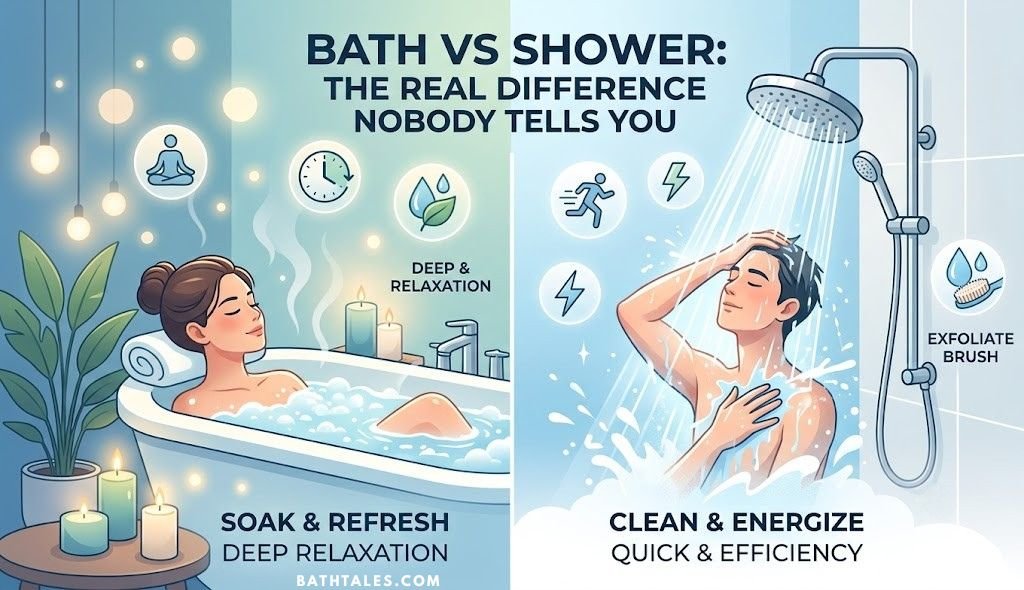
One fills you with heat and time. The other clears you in minutes. Neither is “better” — they’re built for different jobs.
Ask ten people whether a bath or a shower is “better” and you’ll get ten confident, contradictory answers. The truth is that bath vs shower was never a fair fight, because the two routines aren’t trying to do the same thing. A shower is a hygiene tool built for speed. A bath is a physiological and psychological reset that happens to also get you clean. Comparing them head-to-head only makes sense once you separate what each one is actually optimized for.
This guide breaks the debate down by every dimension that actually matters: skin barrier health, hair condition, muscle recovery, stress hormones, sleep architecture, hygiene effectiveness, water and energy cost, and time. By the end, you won’t need someone else’s opinion — you’ll know exactly which routine fits your body, your skin type, your schedule, and your goals, and when it makes sense to use both.
If you’re building a soak-based routine, our guide on the best bath routine is a useful companion to everything covered here.
Quick Verdict: Bath vs Shower At a Glance
If you only have thirty seconds, here’s the short version before we get into the evidence.
You want recovery, not just cleanliness
You’re sore, stressed, dealing with dry or sensitive skin flare-ups, struggling to wind down at night, or you simply have 20–40 minutes to spend on deliberate rest. Baths are a slow-release tool: heat, buoyancy, and stillness working together.
You need speed and daily upkeep
You’re washing off sweat, prepping for the day, sharing one bathroom with a household on a schedule, or living somewhere water and heating costs matter. Showers are efficient, low-maintenance, and better for oily skin and scalp buildup.
| Factor | Bath | Shower |
|---|---|---|
| Average time | 20–40 minutes | 5–10 minutes |
| Water use per session | 70–150 liters | 35–75 liters |
| Muscle recovery | Strong (heat + buoyancy) | Moderate (heat only, briefly) |
| Stress reduction | High (parasympathetic shift) | Mild to moderate |
| Best for oily/acne-prone skin | Less ideal | Better |
| Best for dry/sensitive skin | Better, with the right additives | Can be drying if too hot/frequent |
| Hygiene for removing sweat/oil | Good, if water is changed/not reused | Excellent, continuous rinsing |
| Sleep support | Strong when timed 1–2 hrs before bed | Mild |
| Accessibility (mobility, small bathrooms) | Harder | Easier |
What Actually Happens to Your Body: Bath vs Shower
The core physiological difference between a bath and a shower is exposure time and full-body immersion. In a shower, water contacts your skin briefly and continuously moves across your body before draining away. In a bath, you’re submerged in a static volume of water for an extended period, which changes how your skin, cardiovascular system, and nervous system respond.
Thermoregulation and core temperature
A warm bath (around 40–42°C / 104–108°F) raises your core body temperature gradually and holds it elevated for the duration of the soak. This is why a hot bath can feel like light cardiovascular exercise — your heart rate increases slightly, blood vessels near the skin dilate, and blood pressure can dip as circulation shifts toward the skin’s surface. A shower produces a similar but much shorter-lived effect, because the moment you step out, your skin’s surface temperature drops rapidly.
Cardiovascular response
Sustained warm-water immersion has been studied as a passive way to mimic some cardiovascular benefits of moderate exercise, including modest improvements in blood vessel flexibility over repeated sessions. Showers don’t sustain the exposure long enough to produce the same measurable effect, though a contrast shower (alternating hot and cold) creates its own vascular “pumping” response that some people use for circulation and alertness.
Nervous system shift
Extended warm immersion tends to shift the body toward parasympathetic dominance — the “rest and digest” state — which is one reason baths feel so much more sedating than showers. A quick shower, especially a brisk or cooler one, tends to do the opposite: it’s stimulating, which is exactly why so many people shower in the morning and bathe at night.
The takeaway: a shower is a rinse-and-reset. A bath is a mini physiological intervention. Neither is inherently healthier — they’re tools for different states you’re trying to reach.
Editor’s pick for soak recovery
Mineral-rich bath salts for sore muscles & stress relief
Check price on AmazonSkin Health: Bath vs Shower
Skin outcomes depend far more on water temperature, duration, and what’s in the water than on “bath vs shower” as a category — but there are meaningful default differences between the two routines.
Barrier function and hydration
Hot water, whether in a shower or a bath, strips natural oils from the skin’s outer barrier. The difference is exposure time: a five-minute shower limits that stripping, while a thirty-minute bath in very hot water gives water more time to disrupt the lipid barrier, which can leave skin feeling tight or flaky afterward — especially for people who already have eczema or naturally dry skin.
The fix isn’t to avoid baths; it’s to control temperature (warm, not scalding) and add skin-supportive ingredients. This is where baths actually pull ahead of showers: you can dissolve oils, colloidal oatmeal, or mineral salts directly into a full tub, something a shower can’t replicate in the same way. Our guides on the best bath salts for dry skin and best bath salts for sensitive skin go deeper on formulation choices that protect the barrier instead of stripping it.
Acne and oily skin
For acne-prone or oily skin, showers generally have the edge. Continuous fresh water rinses sweat, sebum, and product residue off the skin and out of the way immediately, rather than letting the skin sit in water that’s slowly picking up oils and debris from the rest of the body. If you’re breakout-prone, a shorter, cooler shower with a gentle cleanser tends to outperform long, hot soaks.
Skin conditions: eczema, psoriasis, and sensitive skin
People with eczema or psoriasis often do better with baths — specifically lukewarm baths with added oils, colloidal oatmeal, or specific mineral salts — because the soak time allows moisturizing ingredients to penetrate before a thin layer of oil is sealed onto damp skin immediately after. See best bath salts for eczema for formulations that are less likely to sting or dry further.
Bath — Skin Pros
- Time for additives (oils, oatmeal, salts) to work
- Full-body soak evens out dry patches
- Good for eczema-prone or very dry skin with the right products
Bath — Skin Cons
- Longer hot-water exposure can over-strip oils
- Not ideal for active acne or fungal skin issues
- Shared bathwater can reintroduce oils/bacteria if soak is very long
Hair Health: Bath vs Shower
Hair care is one area where showers usually win by default, mostly for mechanical reasons rather than biological ones. Rinsing shampoo and conditioner under moving water is simply more thorough than rinsing in a tub, where product residue can redeposit onto hair as the water sits.
Rinsing efficiency
Conditioner buildup is a common cause of limp, dull-looking hair, and it’s almost always a rinsing problem rather than a product problem. A shower’s continuous flow physically carries residue away from the scalp and down the drain. In a bath, unless you’re using a handheld sprayer or pouring fresh water repeatedly, hair sits in the same water the rest of your body is soaking in.
Scalp health
For oily scalps or dandruff-prone scalps, the same logic as oily skin applies: moving water clears sebum and flakes more effectively than static water. If you do wash your hair in the bath, tilting your head back under a handheld showerhead attachment for the rinse step closes most of that gap.
When a bath helps hair
Where baths can help is pre-wash treatments — steaming the hair with heat and humidity before a scalp massage or oil treatment, since the ambient humidity of a hot bath softens hair strands and opens the cuticle slightly, which can make deep conditioning treatments more effective when applied before you shampoo.
Muscle Recovery & Pain Relief
This is where baths have the clearest physiological advantage, and it comes down to two things a shower simply can’t replicate: sustained heat exposure and hydrostatic pressure from full-body immersion.
Heat and blood flow
Warm water dilates blood vessels near the surface of muscles, increasing local blood flow, which can help flush metabolic byproducts that accumulate after intense exercise and ease the sensation of muscle tightness. A shower delivers heat to the skin’s surface for only as long as you stand under it, and typically only to whatever part of the body is directly under the stream at a given moment — never the whole body simultaneously for an extended period.
Hydrostatic pressure
Being submerged to the neck in a bathtub applies gentle, even pressure across the entire body, which can support venous return (blood flow back to the heart) and reduce the feeling of swelling in the legs and feet after a long day standing or a hard workout. This effect is unique to immersion — a shower stream applies localized, uneven pressure that doesn’t create the same systemic effect.
Mineral soaks for soreness
Adding magnesium-rich salts to a bath is one of the most common recovery rituals among people who train regularly, largely because the combination of heat, soak time, and mineral exposure targets soreness from multiple angles at once. If post-workout recovery is your main goal, our roundups on best bath salts for muscle soreness and best bath salts for athletes compare specific formulations. If you’re deciding between the two most common mineral options, Dead Sea salt vs Epsom salt breaks down which is better suited to soreness versus general relaxation, and magnesium flakes vs Epsom salt covers absorption differences in more depth.
| Recovery Factor | Bath | Shower |
|---|---|---|
| Full-body heat exposure | Yes, sustained | Partial, brief |
| Hydrostatic pressure | Yes | No |
| Mineral/salt absorption time | 15–30 min possible | Seconds of contact |
| Convenience post-workout | Lower (needs time) | Higher (quick rinse) |
Mental Health & Stress Relief
The mental health case for bathing is less about the water itself and more about what a bath forces you to do: stop. A shower is compatible with multitasking — most people are still half-thinking about the day ahead while rinsing off. A bath, by design, removes your phone, your to-do list, and your ability to move quickly, which is precisely why it functions as a stress-reduction ritual for so many people.
The physiological stress response
Warm immersion lowers muscle tension and shifts the nervous system toward a calmer state, which can translate into a measurable drop in the subjective feeling of stress after even a single session. Some research on regular warm bathing has linked it to modest mood benefits over time, particularly when it’s used consistently rather than occasionally.
Ritual and mindfulness
There’s also a behavioral component that has nothing to do with water chemistry: a bath is one of the few times many adults are alone, quiet, and not looking at a screen. If you’re trying to build this into an actual practice rather than an occasional treat, how to make a bath more relaxing and how to make a bath comfortable cover the small setup details — lighting, temperature, support — that make the ritual stick.
Worth noting: showers can absolutely be calming too, especially cooler showers used deliberately for a quick mental reset, or steamy showers used as a wind-down substitute when a bath isn’t practical. The stress-relief gap between the two shrinks a lot if you’re intentional about how you shower.
Set the mood for a proper soak
Aromatherapy essential oil sets designed for bathing
Check price on AmazonSleep Quality: Which Routine Helps You Sleep Better
Timing matters more than the routine itself, but baths have a slight structural advantage when it comes to sleep.
The core temperature drop effect
Your body naturally cools its core temperature as part of falling asleep. A warm bath taken 60–90 minutes before bed raises your core temperature temporarily, and the subsequent rapid cooldown after you get out mimics and slightly accelerates your body’s natural pre-sleep temperature drop, which can make it easier to fall asleep faster. This effect has been observed across multiple sleep studies looking at passive body heating before bedtime.
Why a shower is a weaker version of the same trick
A warm shower before bed produces a smaller version of the same temperature-drop effect, since it doesn’t raise core temperature as much or for as long as full immersion. It still helps some people, particularly if it’s part of a consistent wind-down routine, but the effect tends to be milder and shorter-lived than a proper bath.
Practical timing tips
- Aim for 60–90 minutes before your target bedtime, not immediately before lying down
- Keep water warm rather than very hot — very hot water can be overstimulating for some people
- Pair with a relaxation-focused salt blend; see best bath salts for relaxation and sleep for options formulated specifically for this window
- Dim lighting during the bath to avoid signaling your brain that it’s still “daytime”
Hygiene: Which One Actually Gets You Cleaner
This is the most commonly misunderstood part of the debate. Contrary to popular belief, a shower isn’t automatically “cleaner” than a bath — it depends on what you’re trying to remove and how the bath is done.
Removing surface dirt, sweat, and oil
For general daily hygiene, a shower has a structural advantage: dirty water and rinsed-off soap flow away immediately instead of sitting on your skin. In a bath, if you soak in soapy, oily water for a long time without draining and refreshing it, you’re technically resting in a diluted version of everything that just washed off you. This isn’t unhygienic in a harmful sense for most healthy people, but it does mean baths are less efficient than showers at physically carrying debris away.
Where baths hold their own
Baths are still effective for hygiene when done correctly — using enough hot water, adding a mild cleanser, and rinsing off with fresh water (a handheld sprayer or a final rinse) before getting out closes most of the gap. If you’re new to building an effective bath habit rather than just a soak, how do you take a bath and how to bath as a woman both walk through step-by-step hygiene-first bathing routines.
Special hygiene cases
For active infections, open wounds, or after intense sweating from exercise, a shower is generally the more hygienic and lower-risk option, simply because continuous fresh water reduces the chance of recontaminating skin. Baths are a poor choice immediately after activities involving heavy sweat and bacteria load unless followed by a fresh-water rinse.
Water & Energy Usage: Cost and Environmental Impact
On average, a full bathtub uses more water per session than a short shower, but the comparison flips depending on shower length and showerhead flow rate.
| Scenario | Approx. Water Use |
|---|---|
| Standard bathtub, filled two-thirds | ~70–110 liters |
| Deep soaking tub, filled | ~110–150+ liters |
| 5-minute shower, standard showerhead | ~35–50 liters |
| 5-minute shower, low-flow showerhead | ~25–35 liters |
| 15-minute shower, standard showerhead | ~100–150 liters |
The practical conclusion: a quick, low-flow shower typically uses less water than a bath, but a long shower can easily use as much or more water than a bath. Energy cost follows a similar pattern, since heating water is usually the larger cost driver, not the water itself. If cost and sustainability are a priority, shorter showers with a low-flow head are the most efficient option — reserving baths for intentional recovery or wind-down sessions rather than a daily default.
Time Efficiency
There’s no real debate here: showers are faster. A typical shower takes five to ten minutes including hair washing, while a bath — factoring in filling the tub, soaking, and draining — realistically takes twenty to forty minutes from start to finish. For anyone with a tight morning schedule, a household sharing one bathroom, or young kids to get ready, a shower is almost always the more practical daily choice, with baths reserved for evenings or weekends when time is available to actually enjoy the soak rather than rush it.
Who Should Choose a Bath
- People dealing with chronic muscle soreness, tension, or recovering from intense workouts
- Anyone using bathing as a deliberate stress-management or wind-down ritual
- People with dry, sensitive, or eczema-prone skin who benefit from soak time with the right additives
- Pregnant individuals looking for gentle relaxation — with appropriate temperature and product precautions; see best bath salts for pregnancy
- Anyone trying to improve sleep onset through evening temperature-drop timing
- People managing cold and flu symptoms who want the congestion-easing benefit of warm, humid soaking; see best bath salts for cold and flu
Who Should Choose a Shower
- Anyone needing a fast daily hygiene routine, especially on a tight schedule
- People with acne-prone, oily, or fungal-prone skin conditions
- Households sharing limited bathroom time or water heating capacity
- Anyone showering immediately after intense exercise or heavy sweating
- People with mobility concerns where getting in and out of a tub is a safety risk
- Anyone prioritizing lower water and energy use as a daily default
Combining Both: The Hybrid Routine
Most people don’t actually need to pick a permanent side. The most sustainable approach for a lot of households is a hybrid routine: quick showers on weekday mornings for speed and hygiene, with one or two intentional baths per week — typically in the evening — used specifically for recovery, stress relief, and better sleep.
If you want a template rather than building this from scratch, our full bath routine guide lays out a repeatable weekly structure, including how much salt or product to use per soak — a common sticking point covered in detail in how much bath salt to use.
A simple weekly split
| Day | Routine | Purpose |
|---|---|---|
| Mon–Fri mornings | Shower | Fast hygiene, wake-up alertness |
| Post-workout days | Shower first, then optional soak | Rinse sweat, then recover in a bath if time allows |
| 1–2 evenings/week | Bath | Muscle recovery, stress relief, sleep prep |
| Sick days | Bath | Warmth, congestion relief, comfort |
Best Products for Each Routine
The right products make a bigger difference than the routine itself. Here’s what tends to matter most for each.
For bath routines
Mineral salts remain the single most impactful addition to a soak. If you’re unsure where to start, best bath products is a broader roundup, while best organic bath salts and best Himalayan pink bath salt cover specific formulations worth comparing. For detox-focused soaks, see best detox bath salts, and if you’d rather make your own blend at home, how to make bath salts at home walks through simple recipes. One practical note: dissolved salts do have a shelf life once opened — do bath salts expire explains what to watch for.
For shower routines
A good showerhead with adjustable flow, a gentle non-stripping body wash, and a clarifying shampoo for scalp buildup cover most of what a shower routine needs. If oily buildup or product residue is a recurring issue, focusing on rinse time rather than switching products repeatedly usually solves it faster.
Frequently Asked Questions
Is a bath or a shower better for your skin?
It depends on skin type. Dry, sensitive, or eczema-prone skin often benefits from baths with the right additives, since soak time lets moisturizing ingredients work. Oily or acne-prone skin generally does better with showers, since continuous rinsing clears sebum more effectively.
Do baths actually get you as clean as showers?
Yes, if done correctly — using enough warm water, a mild cleanser, and a final fresh-water rinse before getting out. Without a rinse step, baths are slightly less efficient than showers at physically carrying dirt and oil away from the body.
Why do baths help with muscle soreness more than showers?
Baths provide sustained, full-body heat exposure along with hydrostatic pressure from being submerged, both of which support blood flow and reduce the feeling of tightness. A shower only heats whatever part of the body is directly under the water stream, and only briefly.
Is it better to shower or bathe before bed for sleep?
A warm bath taken 60–90 minutes before bed tends to help sleep onset more than a shower, because the rise and subsequent drop in core body temperature more closely mimics the body’s natural pre-sleep temperature decline. A warm shower produces a milder version of the same effect.
Which uses less water, a bath or a shower?
A short, low-flow shower typically uses less water than a full bath. However, a long shower of fifteen minutes or more can use as much or more water than a standard bathtub, so shower length matters as much as the routine itself.
Can taking baths too often dry out your skin?
Yes, especially with very hot water and frequent long soaks without added oils or moisturizing ingredients. Keeping water warm rather than scalding, limiting soak time, and applying moisturizer immediately after helps prevent over-drying.
Are showers or baths better for oily hair?
Showers are generally better for oily hair and scalps, since moving water rinses sebum and product residue more thoroughly than static bathwater. If you wash your hair in the bath, use a handheld sprayer for the rinse step to close most of the gap.
Is it safe to take a bath every day?
For most people, daily baths are safe as long as water temperature stays moderate rather than very hot, sessions aren’t excessively long, and skin is moisturized afterward. People with certain skin conditions should watch for signs of dryness or irritation and adjust frequency accordingly.
Do baths help with stress and anxiety?
Warm baths can lower muscle tension and shift the nervous system toward a calmer state, which many people experience as reduced stress. The ritual itself — stepping away from screens and tasks — also plays a meaningful role in the relaxation effect.
Should I shower after taking a bath?
It’s not required, but rinsing off with fresh water after a long soak — especially one with oils or salts — can help remove any residue left on the skin and is a good habit if the bathwater was used for an extended period.
What’s the best water temperature for a bath versus a shower?
For baths, warm water around 40°C (104°F) balances relaxation with skin safety. For showers, slightly cooler water in the morning can feel more energizing, while warm water in the evening supports wind-down. Very hot water in either case increases the risk of dryness and irritation.
Can pregnant women take baths safely?
Warm (not hot) baths are generally considered safe during pregnancy, with attention to temperature and product ingredients. It’s worth checking with a healthcare provider and choosing pregnancy-appropriate additives rather than assuming all bath products are suitable.
So, Bath or Shower?
The honest answer is that this was never a competition — it’s a toolkit. Showers handle daily hygiene, speed, and oily or acne-prone skin better than anything else. Baths handle recovery, stress relief, sleep support, and dry or sensitive skin better than anything else. The people who get the most benefit from either one aren’t loyal to a single routine — they use showers for upkeep and baths for intentional resets, and let the goal decide which one they reach for.
If you’re ready to build baths into your week properly rather than occasionally, start with our complete bath routine guide and pick one mineral soak that matches what you actually need — recovery, sleep, or skin relief.
Shop bath essentials on Amazon
Pingback: How to Bathe as a Woman: A Complete, No-Nonsense Guide